Zodiac Compatibility Explained: The Science, History, and Psychology Behind the Stars
A comprehensive guide to zodiac compatibility — the psychology that makes it feel accurate, its Babylonian origins, how elements and modalities work, and how to use it as a tool for relationship insight.
Why Millions Swear by It — Even Without Scientific Proof
You have probably read your horoscope at least once. Maybe you dismissed it, maybe you bookmarked the page. Either way, zodiac compatibility explained honestly is not about proving the stars control your love life. It is about understanding why this system has survived for thousands of years, how it actually works, and what you can realistically take from it.
This guide covers the real mechanics behind zodiac compatibility, the psychology that makes it feel accurate, and how to use it as a conversation starter rather than a verdict. If you are looking for a free zodiac compatibility test to try alongside your reading, we will point you there too.
The Barnum Effect and Why "Vague Feels Personal"
In 1949, psychologist Bertram Forer gave his students a personality test. He returned with individualized feedback, and the students rated the accuracy at 4.26 out of 5. The twist? Every student received the exact same paragraph. This became known as the Forer effect, or the Barnum effect, named after P.T. Barnum's famous quote about a sucker born every minute.
Astrological descriptions thrive on this mechanism. When a compatibility reading says, "You value honesty but sometimes struggle to express vulnerability," it feels personal. It applies to nearly everyone. A 1985 study by French statistician Michel Gauquelin found that when people are given their own birth chart alongside someone else's, they cannot reliably tell which is theirs. Yet they still rate both as highly accurate.
This does not mean astrology is useless. It means its power lies in the reflection it prompts, not in celestial causation.
Confirmation Bias in Action
Human brains are pattern-matching machines. When someone tells you that your fire sign makes you passionate and impulsive, you remember the times you acted that way. You forget the times you were cautious and measured. This is confirmation bias, and it is one reason zodiac compatibility feels so spot-on after the fact.
A 2014 study published in the Journal of Consumer Research found that people who believe in astrology are more likely to notice and remember events that confirm their sign's traits. The researchers called this "self-signaling" — the act of using astrological identity to filter real-world experiences. When your compatibility reading says you and your partner will clash over finances, you start watching for financial disagreements. When they happen, the prophecy feels fulfilled.
Understanding this psychology does not ruin the fun. It actually makes the tool more useful because you know what you are working with.
Where Zodiac Compatibility Actually Comes From
Zodiac compatibility explained starts not with romance apps, but with clay tablets in ancient Babylon around 2,400 years ago. Babylonian astronomers divided the ecliptic — the sun's apparent path across the sky — into twelve equal segments. They assigned each segment a constellation name based on what was visible in that region.
Here is what most modern horoscopes do not mention: the Babylonians knew there were actually thirteen constellations along the ecliptic. They left out Ophiuchus to keep the math clean. The twelve-sign system was a convenience, not a cosmic truth.
The Greeks refined this system around the 4th century BCE. Ptolemy's Tetrabiblos became the foundational text of Western astrology, introducing the concept of planetary aspects — angular relationships between celestial bodies that supposedly influence human affairs. Compatibility, in this framework, was not just about sun signs. It was about the geometric angles between two people's entire birth charts.
That history matters because it reveals something important: zodiac compatibility is a cultural technology, not a natural law. It was built by humans to make sense of relationships, and it evolved over millennia.
How the Four Elements Became the Foundation of Compatibility
The Greek philosopher Empedocles proposed around 450 BCE that all matter consisted of four elements: fire, earth, air, and water. By the Hellenistic period, astrologers had mapped these elements onto the zodiac signs:

Understanding zodiac elements compatibility starts with recognizing which element governs each sign. The compatibility rules that emerged from this system are surprisingly consistent across traditions. Fire and air signs get along because fire needs oxygen to burn — a metaphor that translates to "fire inspires, air fans the flames." Earth and water pair well because water nourishes soil, just as emotional depth supports practical stability.
Cross-element pairings are considered more challenging. Fire and water create steam — passion that evaporates. Earth and air feel disconnected — one wants tangibility, the other abstraction.
These are metaphors, not physics. But they are metaphors that have structured how people think about relationships for over two thousand years.
The Modalities: Cardinal, Fixed, Mutable — The Missing Layer
Most online compatibility calculators stop at elements. They miss the second axis: modalities. Every zodiac sign has a modality that describes its approach to change and action.
A cardinal-fire Aries and a fixed-earth Taurus share no element, but their modalities tell a deeper story. Aries wants to start; Taurus wants to maintain. This creates friction, but it can also create balance if both parties recognize the pattern. Two cardinal signs might clash over who leads. Two fixed signs might dig in during arguments. Two mutable signs might never settle on a plan.
Consider how this plays out in real life. A cardinal partner might plan an elaborate surprise date while the fixed partner just wants to revisit the restaurant where they had their first anniversary. The cardinal partner feels bored; the fixed partner feels pressured. Neither is wrong. Their modalities simply prioritize different things. Recognizing this pattern — "I initiate, you sustain" — can turn conflict into collaboration.
When zodiac compatibility explained includes modalities, it becomes significantly more nuanced than the typical "Leo and Aquarius don't match" hot take.
How Zodiac Compatibility Actually Works (The Real Mechanics)
So how does zodiac compatibility work when you look past the horoscope column? The answer involves three layers: elements, modalities, and planetary placements. Most people never get past the first. Let us walk through all three.
Element Pairing: Fire + Air vs. Water + Earth
The element system is the most accessible layer of zodiac compatibility, and it is where most people start. Here is what the traditional framework actually says:
Trine pairings (same element, 120° apart): These are considered the most harmonious. Two fire signs understand each other's need for action. Two water signs intuit each other's emotional currents. The risk? Too much similarity can create stagnation or amplify blind spots.
Sextile pairings (complementary elements, 60° apart): Fire-air and earth-water combinations fall here. They are different enough to create chemistry, similar enough to understand each other. A Gemini (air) and a Leo (fire) might debate for hours, the Gemini feeding ideas, the Leo performing them.
Square pairings (challenging, 90° apart): Same-modality, different-element combinations create tension. Aries (cardinal fire) squares Cancer (cardinal water). Both want to lead, but one leads with action, the other with emotion. These pairings require the most work, but they also drive the most growth.
Opposition pairings (180° apart): Direct opposites on the zodiac wheel. Aries-Libra, Taurus-Scorpio, and so on. Traditional astrology calls these challenging, but modern practitioners often see them as complementary. An opposition forces you to integrate what you lack.
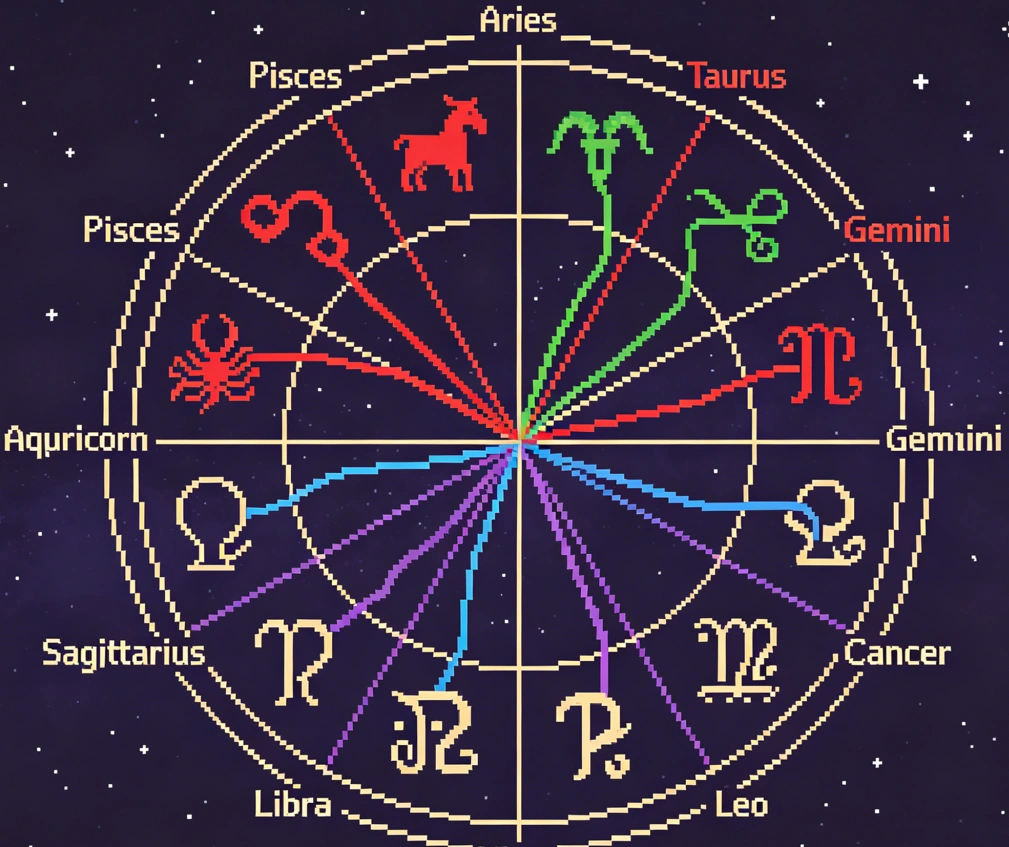
The key insight? No pairing is inherently doomed. The framework describes dynamics, not destinies.
A practical way to think about it: if you are a water sign dating a fire sign, you might feel like your partner never sits with your emotions. They might feel like you dampen their enthusiasm. Neither of you is broken. You are simply speaking different emotional languages. The water partner can learn to appreciate the fire partner's ability to act quickly and bring energy into the room. The fire partner can learn to slow down and validate the water partner's need for emotional depth. Zodiac compatibility explained at this level becomes a manual for translation, not a verdict.
Sun Sign Compatibility: What It Measures (and What It Ignores)
Your sun sign — the sign the sun was in when you were born — represents your core identity, your ego, your conscious self. It is what you read in horoscopes because it is easy to calculate. You only need a birth date.
But sun sign compatibility explained honestly has serious limitations. A 1998 study by psychologist Shawn Carlson, published in Nature, tested astrological predictions under controlled conditions and found no evidence that sun signs predict personality or compatibility. The scientific consensus since then has remained consistent: sun sign astrology does not hold up to empirical testing.
That said, sun sign compatibility remains popular for a reason. It provides a shared language. When two people discover they are both Scorpios, they have an instant conversation topic. When someone learns their partner is a Capricorn, they might approach financial planning differently. The framework creates prompts for reflection, even if the stars are not actually doing the work.
What sun sign compatibility ignores:
- Moon signs: Your emotional needs and instincts
- Rising signs: How you present yourself to the world
- Venus placement: How you express affection
- Mars placement: How you handle conflict and desire
- House positions: Which life areas are most activated
A full natal chart contains ten planets, twelve houses, and multiple aspects. Reducing compatibility to sun signs is like assessing a restaurant by its signage. It tells you something, but not nearly enough.
Moon Signs, Rising Signs, and Why Your "Main" Sign Is Just the Beginning
If sun sign is your headline, moon sign is your emotional interior. It represents how you process feelings, what you need to feel secure, and how you respond under stress. Two people with incompatible sun signs but compatible moon signs often report feeling deeply understood by each other.
Your rising sign (or ascendant) is the mask you wear in public. It determines first impressions and social approach. Someone with a diplomatic Libra rising might smooth over conflicts that their fiery Aries sun would escalate.
Venus and Mars add romantic and sexual chemistry. Venus in Scorpio craves intensity and loyalty. Mars in Gemini approaches desire through words and mental stimulation. When two people's Venus placements align, they tend to express love in ways the other recognizes.
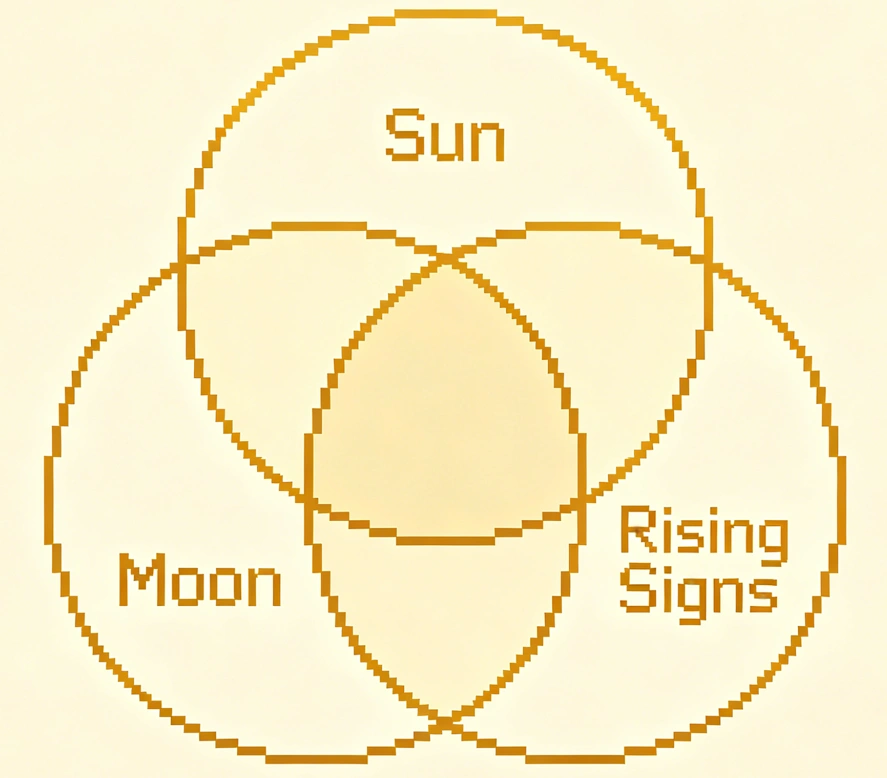
Serious astrologers laugh at sun-sign compatibility calculators for exactly this reason. The real mechanics involve layered interactions across an entire chart. When zodiac compatibility explained includes these layers, it becomes a tool for nuanced self-reflection rather than a simplistic verdict.
Think of it like this. If you only know someone's sun sign, you know what they want to be known for. If you also know their moon sign, you know what keeps them up at night. If you know their rising sign, you know how they walk into a room. If you know their Venus and Mars, you know how they love and how they fight. A complete picture requires all these data points, which is why simplified calculators can only ever scratch the surface.
The Compatibility Patterns Nobody Talks About
When zodiac compatibility is explained only through sun signs, it misses the deeper patterns that determine relationship success. Astrology forums are full of panic posts. "I am a Taurus, they are an Aquarius. Are we doomed?" The short answer: no. The longer answer involves what psychologists call "complementary needs."
"Incompatible" Signs That Actually Work (and Why)
A 2003 study by researchers at the University of Iowa found that successful long-term couples often have complementary rather than similar traits. One partner's strength covers the other's weakness. The anxious person pairs with the calm person. The dreamer pairs with the planner.
In astrological terms, this means square and opposition pairings can be incredibly productive. A practical Virgo and a visionary Sagittarius might frustrate each other daily, but they also prevent each other's excesses. The Virgo keeps the Sagittarius grounded. The Sagittarius keeps the Virgo from getting stuck in details.
Real-world example: Barack Obama (Leo) and Michelle Obama (Capricorn). Leo is fire, fixed, expressive. Capricorn is earth, cardinal, reserved. By element and modality, they are not an obvious match. By complementary function, they are a textbook case of how differences create balance.
Another pattern: mutable signs (Gemini, Virgo, Sagittarius, Pisces) often thrive with anyone because they adapt. A mutable sign can learn to speak fire, earth, air, or water depending on the partner. Their superpower is translation.
A mutable-earth Virgo paired with a fixed-water Scorpio illustrates this beautifully. Virgo wants to fix things, organize them, make them better. Scorpio wants to dive deep, feel intensely, and transform. The Virgo partner might initially find the Scorpio overwhelming. The Scorpio might find the Virgo overly critical. But the Virgo's mutable nature allows them to adjust their approach. Instead of offering solutions, they learn to simply be present. The Scorpio, in turn, learns to appreciate the Virgo's practical care. This is how zodiac compatibility explained through adaptation looks in practice — not about matching perfectly, but about growing into each other's worlds.
The Role of Venus and Mars in Romantic Chemistry
Most compatibility discussions focus on sun and moon. Venus and Mars get overlooked, but they govern the specific dynamics that make or break romantic relationships.
Venus rules attraction, affection, and what you find beautiful. Mars rules desire, aggression, and how you pursue what you want. When someone's Venus aligns with your Mars, the chemistry is often immediate and intense. When they clash, you might find each other attractive but frustrating.
Consider Venus in Leo and Mars in Taurus. Venus in Leo wants grand gestures, public affirmation, dramatic romance. Mars in Taurus wants slow, sensual, private connection. Neither is wrong. But without awareness, Leo feels rejected while Taurus feels overwhelmed.
The actionable insight here is not "find someone with matching Venus and Mars." It is "know what you need, and know what your partner needs, and negotiate the gap." Astrology provides vocabulary for that negotiation.
Consider another example. Venus in Cancer craves nurturing, home-centered affection — cooking together, quiet evenings, emotional safety. Mars in Aries wants spontaneity, pursuit, and physical intensity. A couple with this combination might struggle if the Cancer Venus partner feels the Aries Mars partner is never "just present," while the Aries Mars partner feels the Cancer Venus partner is too clingy. The solution is not to change signs. It is to create rituals that satisfy both — perhaps a weekly adventure date for the Aries energy and a dedicated home evening for the Cancer need.
This is where zodiac compatibility explained moves from theory to practice. The framework gives you a starting point for discussing needs that might otherwise go unnamed.
Mercury Retrograde: What It Actually Tests in Relationships
Mercury retrograde gets blamed for a lot. Texts that don't go through. The conversation that somehow became an argument before anyone understood how. The ex who resurfaces with the timing of someone who has never heard the phrase "leave it alone." Some of this is confirmation bias. But some of it is more interesting — not because Mercury actually governs telecommunications, but because what astrologers identify as "Mercury retrograde energy" maps onto genuine patterns in how people process, communicate, and misread each other.
Astronomically, Mercury retrograde is an optical illusion — because Mercury orbits the Sun faster than Earth, it periodically appears to move backward through the sky from our perspective. This happens approximately three times per year, lasting three to four weeks each time. Astrologically, Mercury governs communication, information processing, contracts, and day-to-day logic. When it retrogrades, the interpretation is that these areas become unreliable — signals get scrambled, plans fall apart, old matters resurface for review.
You don't need to believe in planetary influence to find this framework useful. The questions it asks — what communication patterns are breaking down? what old unresolved matter is coming back up? — are genuinely useful diagnostic prompts for relationships in friction.
The most consistent complaint during Mercury retrograde is that normal communication becomes abnormally effortful. There's a psychological explanation: during periods of heightened external stress, collective attention gets fragmented. Mercury retrograde periods often coincide with seasonal transitions, which carry their own stressors. When everyone around you is slightly more distracted, slightly more stressed, slightly less available to receive information carefully, communication errors increase.
This matters for relationships because communication quality degrades predictably under stress — and predictably in different ways depending on personality. Intuition-dominant types tend to communicate by implication and inference. During high-stress periods, their reliance on context and subtext becomes a liability: they assume their partner is reading the same implication they intended. Sensing-dominant types tend to communicate more literally. Their breakdown pattern is different: they may miss the emotional subtext of what a partner is communicating, interpret a tonal signal as a factual statement, or not register that something is wrong until it's been stated plainly.
Where Mercury retrograde intersects most directly with relationship dynamics is in how it activates existing attachment patterns. For anxiously attached individuals, every ambiguous text becomes a potential sign of withdrawal. For avoidantly attached individuals, communication friction provides cover for the distance they were already seeking. For securely attached individuals, the same chaos registers as an inconvenience rather than a threat. Mercury retrograde doesn't create attachment patterns. It reveals them.
The deepest insight in the retrograde framework isn't about communication tools or ex-partner timing. It's that periods of disruption reveal the underlying robustness of a relationship's foundation. Couples with strong communication foundations don't fall apart during Mercury retrograde. Couples with fragile communication foundations experience disruption as catastrophic — not because the disruption is extraordinary, but because the foundation was already insufficient to absorb ordinary friction.
Concrete things that improve communication during high-stress periods, regardless of planetary position: Over-communicate intent — "I'm not upset, I'm just distracted" prevents an hour of misread silence. Delay significant conversations — important conversations held under stress tend to go worse. Revisit what's been unresolved — retrograde's backward-looking energy is genuinely useful for addressing things that have been tabled. Distinguish the planet from the pattern — when a communication breakdown happens, the useful question isn't "is this because of Mercury?" It's "what's the actual communication pattern here, and what does it tell us?"
Astrological frameworks are most useful when they function as prompts for self-examination rather than explanations that externalize responsibility. Mercury retrograde, used well, asks: what in this relationship needs clearer communication, more honest review, or more deliberate attention? That's a useful question regardless of what Mercury is doing.
From Chart to Conversation — Using Compatibility Insights in Real Life
Bringing astrology into a relationship conversation can feel risky. You do not want to sound like you are making excuses or reducing your partner to a stereotype. A framework that actually works:
How to Talk About Zodiac Differences Without Sounding Ridiculous
Step 1: Frame it as a language, not a verdict.
Instead of: "You are such a typical Gemini."
Try: "I read that Gemini communication style tends toward rapid idea generation. Does that resonate with you?"
Step 2: Focus on dynamics, not labels.
Instead of: "We are incompatible because you are fire and I am water."
Try: "I notice I tend to process things emotionally first, while you want to act immediately. How can we bridge that gap?"
Step 3: Use it to name patterns, not predict outcomes.
Instead of: "Mercury retrograde is why we are fighting."
Try: "We seem to miscommunicate most when one of us is stressed about work. What triggers should we watch for?"

The goal is not to let astrology run your relationship. The goal is to borrow its vocabulary for conversations you might otherwise avoid.
When Compatibility Becomes a Red Flag
There is a dark side to zodiac compatibility explained poorly. When people use astrology to justify bad behavior, avoid difficult conversations, or write off relationships without effort, the tool becomes harmful.
Red flags to watch for:
- "I can't help it, I am a Scorpio." No sign excuses manipulation, jealousy, or controlling behavior.
- "We are not compatible, so why try?" Compatibility is dynamic, not fixed. Effort matters more than charts.
- "My sign needs someone who..." This frames relationships as transactions rather than collaborations.
- Using compatibility to avoid commitment. If someone cites sun sign mismatch as a reason not to commit, the issue is rarely astrological.
A healthy approach treats zodiac compatibility as one lens among many. It sits alongside communication skills, shared values, life goals, and emotional maturity. No chart replaces those fundamentals.
Try It Yourself — Beyond Just Reading
Reading about zodiac compatibility is a start. Testing it with real data is where it gets interesting. Our free zodiac compatibility test lets you input two birth dates and explore how your elements, modalities, and planetary placements interact.
If you want to go deeper, try comparing your zodiac results with an MBTI compatibility test. MBTI measures psychological preferences — how you process information, make decisions, and organize your life. Where zodiac offers archetypal language, MBTI offers cognitive frameworks. Together, they give you a richer picture than either alone.
For emotional rhythm compatibility, our moon phase compatibility test looks at how your birth moon phases align. Some people find this layer surprisingly resonant for understanding emotional cycles in relationships.
And if you are curious about a newer personality framework, the SBTI personality test offers a fresh angle on how your traits shape your connections with others.
The point is not to collect labels. The point is to gather perspectives that help you understand yourself and your partner better.
FAQ
Is zodiac compatibility scientifically proven?No. Zodiac compatibility is not scientifically proven. Multiple large-scale studies, including Shawn Carlson's 1985 double-blind test published in Nature, have found no empirical support for astrological predictions. A 2003 review by former astrologer Geoffrey Dean analyzed over 40 controlled studies and concluded that astrology performs no better than chance.That said, the absence of scientific proof does not mean astrology has no value. It functions as a reflective tool, a cultural language, and a conversation prompt. Its benefits are psychological and social, not astronomical.
What's more important — sun sign or moon sign compatibility?For surface-level attraction and social compatibility, sun sign matters more. For emotional security and long-term intimacy, moon sign often matters more. Most astrologers would say a compatible moon pairing sustains a relationship longer than a compatible sun pairing.In practice, neither operates in isolation. A challenging sun-moon combination can be navigated with awareness. A compatible sun-moon pairing still requires communication and effort.
Can incompatible zodiac signs make it work?Absolutely. "Incompatible" in astrological terms usually means challenging aspects — squares and oppositions. These create friction, but friction generates heat, and heat can forge strong bonds. The research on complementary traits in relationships supports this: differences drive growth when both parties are willing to engage with them.What breaks relationships is not sign mismatch. It is unwillingness to understand each other, refusal to compromise, or fundamental value differences that no chart can fix.
How accurate are online zodiac compatibility calculators?Most online calculators use only sun signs, which limits their accuracy significantly. They can describe general dynamics — "fire and air tend to get along" — but they miss the nuances of moon signs, Venus placements, and house positions.A calculator that asks for full birth dates, times, and locations will be more nuanced. But even then, remember what the calculator is doing: applying symbolic rules to astronomical data. It is not measuring a physical force.Use calculators as starting points for reflection, not as verdicts.
What's the difference between Western and Chinese zodiac compatibility?Western zodiac is based on the sun's position relative to twelve constellations over a year. Chinese zodiac is based on a twelve-year cycle, with each year assigned an animal sign. The systems are entirely independent.Western compatibility focuses on elements, modalities, and planetary aspects. Chinese compatibility focuses on animal characteristics and the five elements (wood, fire, earth, metal, water) in a different framework.Some people find one system resonates more than the other. Some use both. Neither has scientific validation, but both offer structured ways to think about personality and relationships.
Does birth time matter for zodiac compatibility?Birth time matters significantly if you want a complete compatibility picture. Your rising sign changes approximately every two hours, and your moon sign changes every two to three days. Without an accurate birth time, you cannot determine your rising sign or the exact positions of planets in your houses.For basic sun sign compatibility, birth time is irrelevant — you only need the date. But for a full natal chart comparison, astrologers typically ask for date, time, and location. The location matters because it determines which signs were rising on the eastern horizon at your birth moment.If you do not know your exact birth time, many astrologers use a noon default or work with what is called a "solar chart," which places your sun sign in the first house. This is less precise but still useful for general insights.
Can zodiac compatibility predict friendship and family relationships too?Absolutely. While romantic compatibility gets the most attention, zodiac compatibility explained applies to any relationship dynamic. A parent and child with clashing modalities might benefit from understanding why they approach change differently. Two coworkers with complementary elements might make an excellent project team.The same principles apply: elements describe energy styles, modalities describe action styles, and planetary placements describe specific needs. A fire-sign boss might appreciate an air-sign employee who generates ideas quickly. An earth-sign friend might provide grounding for a water-sign friend going through emotional turbulence.The framework is versatile because it is fundamentally about understanding human differences, not just romantic chemistry.
Final Thoughts
Zodiac compatibility explained honestly is neither magic nor nonsense. It is a centuries-old framework for thinking about human differences, built on metaphor, observation, and cultural transmission. The stars do not determine your relationships. But the language of astrology can help you talk about them.
The most useful compatibility insight is not "you two are a perfect match." It is "here is a pattern to notice, here is a difference to navigate, and here is a conversation to have." That is where the real value lives. When zodiac compatibility explained moves beyond simplified sun-sign matching, it becomes a genuine tool for relationship insight.
If you are curious how your sign interacts with someone else's, take our free zodiac compatibility test and see what patterns emerge. The stars might not control your fate, but they can definitely give you something interesting to talk about over dinner.
Want more? Explore our other compatibility guides for deeper insights into relationships and personality.