Moon Phase Compatibility Test: How Lunar Rhythms Shape Emotional Connection (And What to Do With Your Results)
A comprehensive guide to our moon phase compatibility test — how lunar rhythms map your emotional patterns, what your birth moon phase reveals, how our scoring system works, and how to use your results to improve your relationships.
Why Moon Phase Compatibility Feels Different From Other Tests
Most compatibility frameworks feel static. They give you a type, a label, a category — and then you're supposed to figure out how two categories interact. Moon phase compatibility doesn't work that way. It treats emotions as cyclical, not fixed.
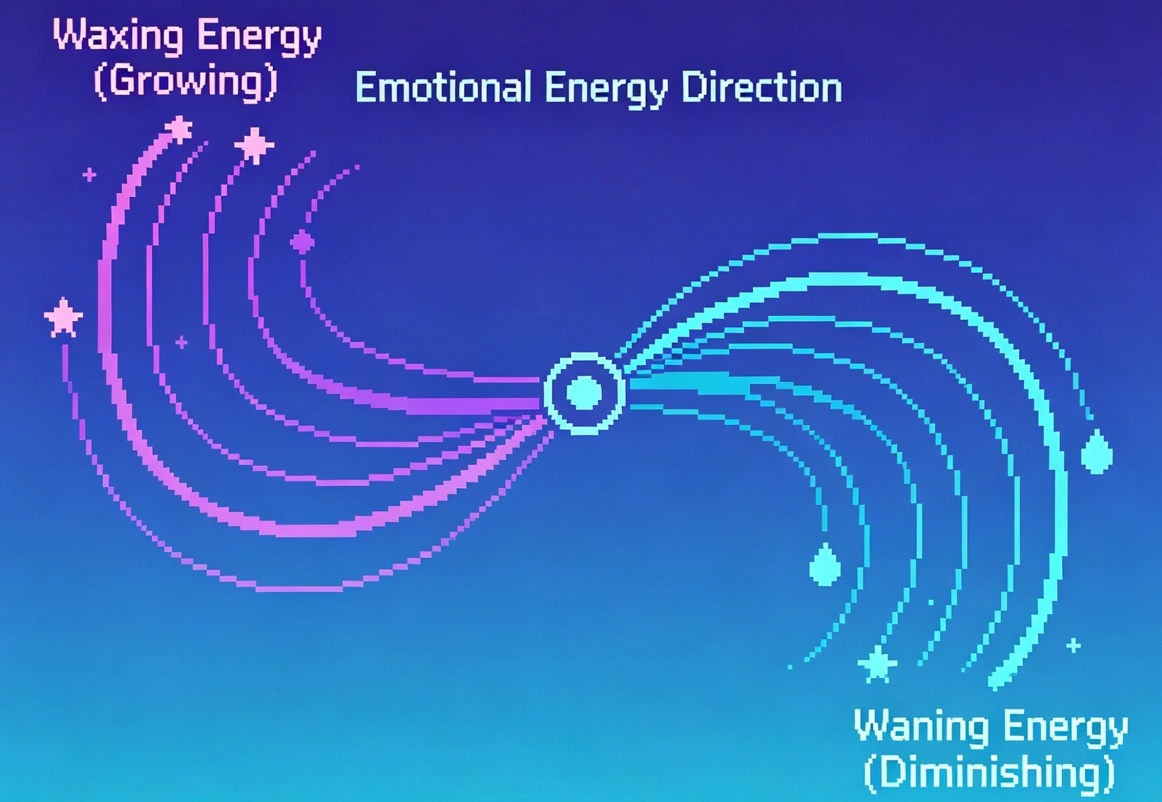
Think of it like meteorology. A weather forecast doesn't tell you what kind of climate you live in — it tells you what conditions to expect today, how they might shift tomorrow, and what patterns tend to repeat. Moon phase compatibility does the same for emotional dynamics.
Someone born under a Waxing Gibbous moon tends to express emotions outwardly and build connections actively. Someone born under a Waning Crescent moon processes feelings inwardly and needs solitude to recharge. Put them together, and you've got a fascinating but potentially challenging combination: one partner wants to talk through everything immediately, while the other needs space before they can even identify what they're feeling.
This isn't about "compatibility" in the fairy-tale sense. It's about predictable emotional friction points — and the specific communication strategies that help navigate them.
Sarah, a 29-year-old graphic designer from Portland, discovered this the hard way. She and her partner scored a 95 on our moon phase compatibility test — the highest possible score. "I thought that meant we'd never fight," she told us. "But the report explained that our high score came from being polar opposites — New Moon and Full Moon — which creates intense attraction but also intense miscommunication. Once I understood that his need to process everything internally wasn't rejection, and he understood that my need to talk immediately wasn't pressure, we stopped having the same argument every month."
What Other Tests Measure vs. What Moon Phase Measures
No single test captures the full picture. But moon phase compatibility addresses a dimension that the others almost entirely ignore: the temporal dynamics of emotion. How quickly do you move from feeling to expression? Do you need to sit with emotions before sharing them, or does sharing help you process? Do your emotional energies build over time, or do they peak and fade quickly?
These aren't abstract questions. They're the exact dynamics that determine whether a disagreement escalates or resolves, whether a partner feels supported or suffocated, and whether emotional intimacy deepens or stalls.
What Your Birth Moon Phase Actually Reveals
Your birth moon phase is the specific point in the lunar cycle when you were born. Unlike your sun sign, which stays the same for about 30 days, moon phases change every 3–4 days. This means two people born a week apart in the same month can have completely different emotional profiles.
How Birth Moon Phase Is Calculated (Astronomically)
We calculate birth moon phase using standard astronomical algorithms, not estimated date ranges. Our system uses a known new moon as a reference point and counts the days between that reference and your birth date, then maps the result onto the 29.53-day lunar cycle.
Each phase occupies roughly 3.69 days within that cycle:
- New Moon: Days 0–3.69
- Waxing Crescent: Days 3.69–7.38
- First Quarter: Days 7.38–11.07
- Waxing Gibbous: Days 11.07–14.76
- Full Moon: Days 14.76–18.45
- Waning Gibbous: Days 18.45–22.14
- Last Quarter: Days 22.14–25.83
- Waning Crescent: Days 25.83–29.53
This calculation uses real astronomical data. We're not using simplified sun-sign-style date ranges that lump everyone born in a two-week window into the same category.
The Eight Phases and Their Emotional Signatures
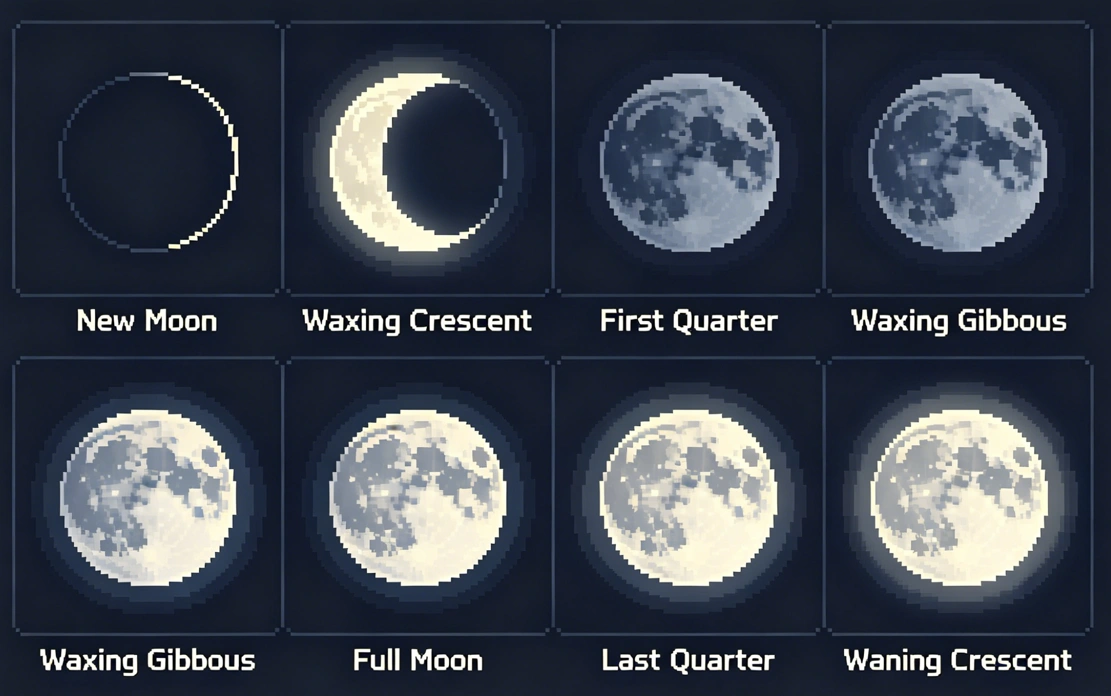
If you were born during the New Moon, you probably carry inward-focused, water-element energy. You process emotions privately, need significant alone time, and often have a rich inner world that others don't easily see. You're the one who seems calm on the surface while feeling everything intensely underneath.
Waxing Crescent people build emotional connections slowly and carefully, like tending a garden. Once they've invested, they're remarkably loyal — but they need time to warm up. Their growing earth-element energy makes them patient builders of emotional security.
People born under the First Quarter moon tend to be emotionally assertive. They know what they feel and they're willing to work for it. This directness can be refreshing or intimidating, depending on the partner. Their growing fire-element energy pushes them to act on their emotions rather than sit with them.
Waxing Gibbous people are emotionally expressive and communicative. They often serve as bridges between different emotional styles in a group, processing feelings by talking them through. Their growing air-element energy makes them natural emotional translators.
The Full Moon carries peak water-element energy. If this is your birth phase, you feel everything intensely and visibly. When you're happy, the whole room knows. When you're upset, it's equally apparent. This transparency is magnetic but can overwhelm partners who prefer contained expression.
Waning Gibbous people are reflective and analytical about emotions — the ones who want to talk through feelings after the initial intensity has passed. Their decreasing air-element energy makes them excellent mediators who can see all sides once the storm has cleared.
If you were born during the Last Quarter, you're emotionally decisive, sometimes to the point of cutting things off before you've fully processed them. You value emotional independence and can feel suffocated by partners who need constant reassurance. Your decreasing fire-element energy wants to resolve and move on.
Waning Crescent people are the most emotionally self-contained of all the phases. They need long periods of solitude to process feelings and typically express care through practical actions rather than words. Their decreasing earth-element energy makes them quiet anchors in chaotic emotional waters.
Growing vs. Waning: The Core Energy Divide
The most important distinction isn't which specific phase you were born under — it's whether your phase is growing (waxing) or decreasing (waning).
Growing-phase people (Waxing Crescent, First Quarter, Waxing Gibbous) share an outward, building emotional energy. Their emotional process expands: they feel, then express, then seek connection. They're energized by emotional engagement.
Decreasing-phase people (Waning Gibbous, Last Quarter, Waning Crescent) share an inward, reflective emotional energy. Their emotional process contracts: they feel, then withdraw, then integrate. They're depleted by too much emotional engagement and need recovery time.
This divide explains more relationship friction than any specific phase pairing. A growing-phase person experiences a decreasing-phase partner's withdrawal as rejection. A decreasing-phase person experiences a growing-phase partner's pursuit as pressure. Both are misreading the same signal: different emotional metabolism rates.
How Moon Phase Compatibility Scoring Works
Our compatibility scoring is built around three principles: energy direction alignment, elemental resonance, and phase-specific dynamics.
The Three-Layer Framework: Direction, Element, Phase Dynamic
Energy direction matters most. When a growing-phase person pairs with a decreasing-phase person, they score 85 — their rhythms naturally complement each other. Two growing-phase people score 75. They amplify each other, which can be exhilarating or exhausting depending on the day.
Elemental resonance adds an 80-point baseline when both phases share the same element. Water-water pairings understand each other's depth, but they might also drown together in shared melancholy. Fire-fire pairings ignite passion, yet they risk burning out just as quickly.
Phase-specific dynamics capture the unique chemistry between particular combinations. New Moon plus Full Moon creates the most dramatic polarity in the entire cycle — a score of 95. Same-phase pairings score 90, offering deep understanding but also shared blind spots.
Why Opposites Score Higher Than Matches (Usually)
The highest compatibility score — 95 — goes to New Moon and Full Moon pairings. This seems counterintuitive. Shouldn't similar people be more compatible?
Not necessarily. In emotional dynamics, complementary rhythms often create more sustainable balance than identical rhythms. A New Moon person (maximum inward focus) paired with a Full Moon person (maximum outward expression) creates a natural equilibrium. Each has what the other lacks, and if they learn to bridge their different processing styles, they can cover each other's emotional blind spots.
The catch: this pairing requires the most explicit communication, because their natural processing styles are almost opposite. The New Moon partner needs to learn that the Full Moon partner's immediate emotional expression isn't drama — it's just how they process. The Full Moon partner needs to learn that the New Moon partner's silence isn't withdrawal — it's integration.
Same-Phase Pairings: Double-Edged Swords
Same-phase pairings score 90 — high, but with a caveat. Two Full Moon people understand each other's emotional intensity instinctively, but they might also escalate each other's reactions. A small conflict can become a theatrical production because both partners amplify emotional expression.
Two New Moon people respect each other's need for space, but might struggle to initiate emotional conversations. They can coexist peacefully while both privately wondering if the other is actually happy.
The research on similarity vs. complementarity in relationships is mixed. A 2023 meta-analysis published in Personality and Social Psychology Review found that similarity predicts relationship satisfaction in the short term, but complementarity predicts longevity — especially in emotional regulation patterns. Couples with different but complementary coping styles reported 23% higher relationship satisfaction at the five-year mark compared to couples with identical styles.
Moon Phase vs. MBTI vs. Zodiac: Three Lenses on the Same Relationship
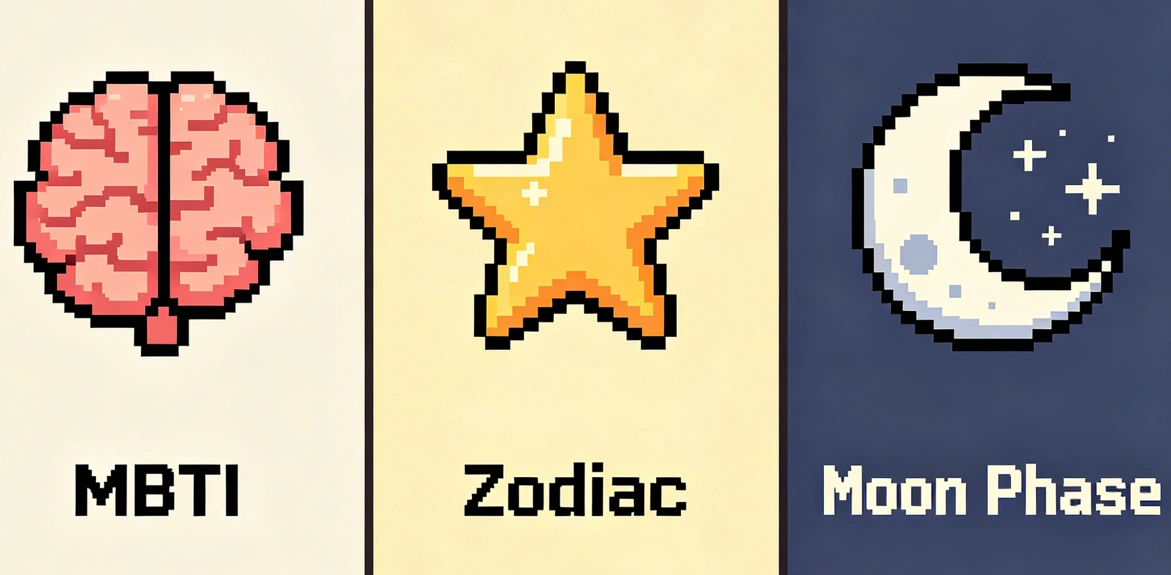
No compatibility system is complete. The smartest approach is using multiple lenses and looking for convergent patterns.
What Each System Actually Measures
MBTI analyzes cognitive architecture. It tells you how you process information, make decisions, and orient yourself to the world. An INTJ and an ENFP might have completely different moon phases but share MBTI-compatible thinking patterns — or vice versa.
Zodiac analyzes elemental and modal energies. Your sun sign tells you what drives you at a fundamental level — fire signs need action, earth signs need stability, air signs need ideas, water signs need emotional depth. Our zodiac compatibility test explores these elemental interactions.
Moon Phase analyzes emotional rhythm. It tells you how your feelings move — outward or inward, building or releasing, fast or slow. This is the dimension most other tests miss entirely.
When Moon Phase Adds Value the Others Miss
Consider two people who both test as INTJ on MBTI and both are Capricorn sun signs. By those metrics, they should be highly compatible — similar thinking style, similar drive for achievement, similar reserved demeanor.
But if one was born under a Waxing Gibbous moon and the other under a Waning Crescent moon, their emotional rhythms are almost opposite. The Waxing Gibbous INTJ Capricorn wants to talk through problems immediately, using emotional expression as a tool for resolution. The Waning Crescent INTJ Capricorn needs to withdraw and process internally before any discussion can be productive.
Without understanding the moon phase dynamic, both partners would likely conclude that the other is "being difficult" or "doesn't care." In reality, they're just running on different emotional operating systems.
Using All Three Together (Without Overwhelming Yourself)
You don't need to become a compatibility scientist. Here's a practical framework:
- Start with moon phase for emotional dynamics — this is where most daily friction lives
- Add MBTI for communication strategy — how do you each prefer to discuss problems?
- Use zodiac for long-term value alignment — do you want the same things from life?
If all three align, you've got strong convergence. If two align and one contradicts, that specific dimension needs attention. If all three contradict, well — at least you know what you're working with.
Our MBTI compatibility test integrates with moon phase analysis to give you a more complete picture than either test alone.
Real Relationship Scenarios: What the Test Actually Looks Like
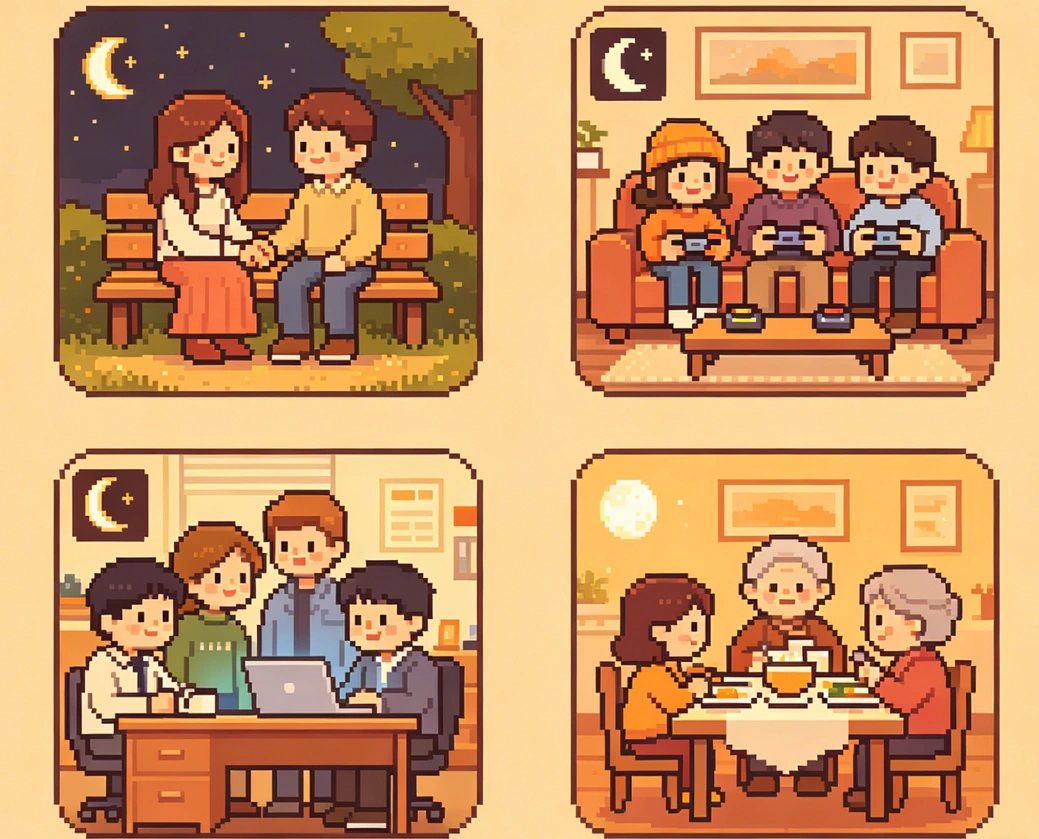
The same moon phase pairing plays out differently depending on relationship context. Our moon phase compatibility test adjusts its analysis based on whether you're exploring romantic, friendship, professional, or family dynamics.
Romantic Relationships: Emotional Intimacy Patterns
Romantic relationships are where moon phase compatibility gets personal. It predicts emotional intimacy rhythm — how quickly each person wants to deepen connection, how they handle conflict, and what they need to feel loved.
A Waxing Crescent + Last Quarter pairing illustrates this well. The Waxing Crescent partner builds emotional connection gradually, wanting to feel secure before opening up fully. The Last Quarter partner is emotionally decisive — they might commit quickly but also need significant independence within the relationship.
The friction point: the Waxing Crescent partner experiences the Last Quarter partner's independence as distance, while the Last Quarter partner experiences the Waxing Crescent partner's need for security as clinginess. The solution is explicit scheduling: the Last Quarter partner commits to regular check-ins, and the Waxing Crescent partner commits to respecting solo time.
Friendships: Social Energy and Support Styles
Friendships run on a different emotional fuel than romance. Here, moon phase compatibility predicts social energy exchange — how you each recharge, how you support each other through difficulty, and what "being a good friend" looks like to each of you.
Two Waxing Gibbous friends might have an incredibly active friendship — constant communication, frequent plans, processing every life event together. But they might also exhaust each other because neither provides the quiet, grounding presence that emotional processing sometimes needs.
A Waxing Gibbous + Waning Crescent friendship can be remarkably balanced. The Waxing Gibbous friend brings energy and initiative; the Waning Crescent friend brings depth and reflection. The risk is the Waning Crescent friend feeling overwhelmed by social demands, or the Waxing Gibbous friend feeling like they're carrying the friendship.
Professional Partnerships: Stress Response Compatibility
In professional partnerships, moon phase compatibility predicts how you handle pressure together. It maps stress response patterns — how each person handles pressure, makes decisions under stress, and recovers from setbacks.
A First Quarter + Waning Gibbous professional pairing can be powerful. The First Quarter partner drives action and makes decisive calls under pressure. The Waning Gibbous partner reflects on outcomes and prevents repeated mistakes. But during acute crisis, their different speeds become visible: the First Quarter partner wants to act immediately, while the Waning Gibbous partner wants to analyze before responding.
The most effective professional pairings establish clear roles: who drives immediate response, who handles post-crisis review, and how decisions get made when speed and analysis conflict.
Family Dynamics: Nurturing Patterns Across Generations
Family dynamics are where moon phase compatibility explains patterns you've probably noticed but couldn't name. It reveals nurturing style differences — how each person shows care, what they need to feel supported, and why family gatherings can feel so emotionally chaotic.
A parent-child pairing where both are Full Moon phases creates intense emotional connection but also intense conflict. Both feel everything visibly, which means small disagreements become dramatic events. But it also means love is expressed abundantly and unmistakably.
The same Full Moon parent with a New Moon child faces a different challenge: the parent's emotional expressiveness can overwhelm the child's need for quiet processing. The child might withdraw, which the parent interprets as rejection. Understanding that the child needs space to feel before connecting can transform this dynamic.
The Honest Limitations Nobody Talks About
Most articles about moon phase compatibility either treat it as mystical truth or dismiss it entirely. Neither position is particularly useful. Here's what we actually know and don't know.
The Science Gap (And Why It Might Not Matter)
There is no peer-reviewed research supporting the claim that birth moon phases influence emotional patterns. The moon's gravitational effects on tides are well-established, but the idea that these effects scale to human emotions has no empirical support. Our scoring system is based on astrological tradition and logical frameworks about energy direction and elemental affinity, not on controlled studies.
That said, the narrative framework itself has psychological value. Research in narrative psychology (McAdams, 2008; Pennebaker, 2011) consistently shows that having a framework for understanding relationship dynamics — even a fictional one — improves communication and relationship satisfaction. The framework gives people language for experiences they couldn't previously articulate.
When Sarah from Portland says her relationship improved after understanding her moon phase compatibility, the mechanism might not be lunar energy. It might be that the framework gave her and her partner a shared vocabulary for their different emotional processing styles — a vocabulary they didn't have access to before.
The Eight-Phase Simplification Problem
In reality, the moon's phase is a continuous spectrum, not eight discrete categories. Two people born one day apart might be assigned to different phases even though their actual lunar positions are nearly identical. Our 3–4 day phase boundaries create clean categories at the cost of precision at the edges.
This is a genuine limitation. If you were born right on a phase boundary, your "true" emotional profile might blend characteristics from both adjacent phases. We address this in our test by noting boundary cases and suggesting you read both phase descriptions.
Birth Time Precision We Don't Account For
In precise lunar astrology, the exact time and location of birth can shift the moon's phase by several hours — potentially moving someone from one phase category to the next. Our date-based calculation doesn't capture this level of precision.
If you know your exact birth time and want maximum accuracy, a detailed lunar chart from an astrologer will give you more precise information. For most people, the date-based calculation is sufficient to identify the correct phase or a close adjacent phase.
How to Actually Use Your Results
Getting your score from a moon phase compatibility test is the easy part. Knowing what to do with it is where value actually lives.
If Your Score Is High (85–95)
A high score feels good. It means your emotional rhythms either complement or resonate with each other. But here's the thing nobody tells you: high compatibility doesn't mean effortless relationship. It means the potential is there. You still have to do the work.
Action items:
- Identify your specific friction points (even high-scoring pairings have them)
- Develop explicit communication protocols for those friction points
- Don't take the good dynamics for granted — complementary rhythms still need practice
A New Moon + Full Moon pairing with a 95 score on our moon phase compatibility test still needs to learn how to bridge their opposite processing styles. The score tells them the potential is there; it doesn't do the bridging for them.
If Your Score Is Moderate (70–84)
Moderate scores indicate workable but imperfect alignment. These pairings often have one dimension that works well and another that requires conscious effort.
Action items:
- Identify which dimension (direction, element, or phase dynamic) is creating the friction
- Focus your communication efforts on that specific dimension
- Consider whether the friction is in a domain that matters for your relationship type
A romantic pairing with moderate moon phase compatibility but strong MBTI compatibility might find that their thinking and decision-making styles align beautifully, but their emotional processing rhythms clash. The solution: use MBTI-compatible communication strategies to discuss moon-phase-incompatible emotional needs.
If Your Score Is Low (Below 70)
Low scores indicate significant emotional rhythm misalignment. This doesn't mean the relationship is doomed — it means you'll need more explicit structure to bridge your different emotional styles.
Action items:
- Establish explicit emotional check-in schedules (don't rely on spontaneous sync)
- Create separate spaces for processing (don't force simultaneous emotional engagement)
- Use written communication for important emotional topics (reduces real-time processing pressure)
- Consider whether this specific relationship type benefits from high emotional sync
A professional partnership with low moon phase compatibility can still be highly effective if the partners establish clear role boundaries and use structured communication. A romantic relationship with low moon phase compatibility requires more intentional work but can succeed if both partners are committed to bridging their differences.
The 30-Day Emotional Rhythm Experiment
Regardless of your score, try this: for 30 days, track your emotional energy levels and your partner's (or friend's, or colleague's). Note when you feel most expressive, most withdrawn, most receptive, and most irritable. Don't try to change anything — just observe.
At the end of 30 days, compare your patterns. You'll likely find that your moon phase compatibility score predicted at least some of your observable rhythms. More importantly, you'll have concrete data about when you're each most available for emotional connection — and when you're not.
Try the Moon Phase Compatibility Test
If you've read this far, you probably have a good sense of whether this framework resonates with you. The best way to find out is to try it.
Our free moon phase compatibility test calculates your birth moon phase using real astronomical data, scores your compatibility with any partner, and generates a detailed AI analysis of your emotional dynamics — including specific communication strategies for your pairing.
No signup required. Results are instant. And if the analysis doesn't resonate with your experience, you've lost nothing but a few minutes. If it does, you've gained a new framework for understanding one of the most important dimensions of your relationships.
Frequently Asked Questions
How accurate is moon phase compatibility?
Moon phase compatibility is not scientifically validated in peer-reviewed research. Its value lies in providing a structured framework for understanding emotional dynamics — a framework that many people find surprisingly resonant with their lived experience. Think of it as a lens, not a verdict.
Can two people with incompatible moon phases make it work?
Absolutely. Low compatibility scores indicate different emotional rhythms, not incompatibility. Many successful relationships involve partners with very different emotional processing styles. The key is explicit communication about those differences, not expecting spontaneous alignment.
What's the difference between moon sign and moon phase compatibility?
Your moon sign is determined by which zodiac constellation the moon was in when you were born — it changes roughly every 2.5 days. Your moon phase is determined by where the moon was in its cycle relative to the sun — it changes every 3–4 days. They're related but distinct. Moon sign compatibility looks at elemental and modal energies; moon phase compatibility looks at energy direction and emotional rhythm.
How is birth moon phase calculated?
Birth moon phase is calculated by determining the moon's position in its 29.53-day cycle relative to the sun on your birth date. Our system uses astronomical algorithms with a known new moon reference point to calculate this precisely from your birth date.
Does birth time affect my moon phase?
Birth time can shift the moon's exact phase by several hours, potentially moving someone born right on a phase boundary into an adjacent phase. For most people, date-based calculation is sufficient. If you were born within a few hours of a phase boundary and know your exact birth time, a detailed lunar chart can provide more precision.
Is moon phase compatibility scientifically proven?
No. There is no peer-reviewed scientific evidence that birth moon phases influence personality or relationship outcomes. Moon phase compatibility is best understood as an interpretive framework — a tool for thinking about emotional dynamics, not a scientific measurement of them.
Final Thoughts
Moon phase compatibility won't predict your relationship's future. No test can. What it can do is give you language for emotional dynamics you might have sensed but couldn't articulate — and specific strategies for navigating the rhythms that make every relationship unique. Take the moon phase compatibility test and see what lunar rhythms reveal about your connections.