MBTI Compatibility Test: What It Reveals & Doesn't
Your MBTI compatibility test score is just 20% of the story. Discover why attachment style matters 4x more—and exactly what to do after your result.
Take the MBTI Compatibility Test First
Before we unpack what your score actually means, go get one. Head over to compatibility.work and take the free MBTI compatibility test—it takes about five minutes, and having your result in hand will make everything that follows way more useful. Think of it as getting your lab results before the doctor's explanation. No pressure, no commitment, just data.
What Your MBTI Compatibility Score Actually Measures
An MBTI compatibility test measures how naturally your cognitive preferences align with someone else's across four dimensions. It's not measuring your destiny—it's measuring the friction points in how you both process the world. Let's break down what's actually in that score—and what's suspiciously absent.
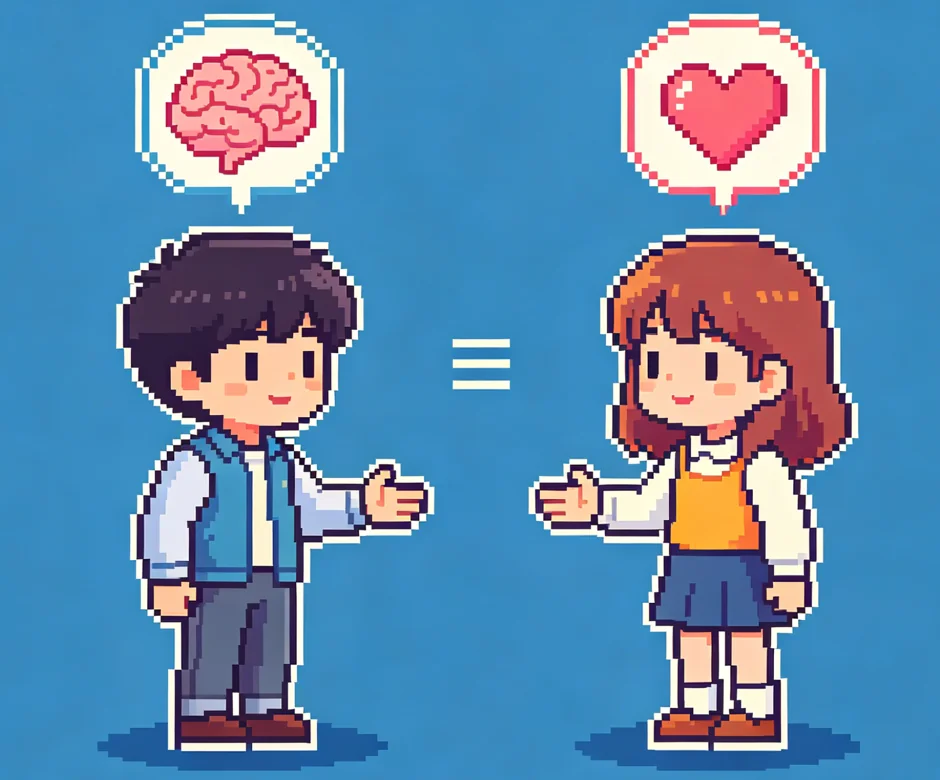
The 4 Dimensions That Drive Your Score (E/I, S/N, T/F, J/P)
Your MBTI compatibility score is built from four preference pairs:
Extraversion vs. Introversion (E/I): Where you recharge—outer stimulation or inner reflection. An E/I pair often navigates social energy differently, which can be a source of either balance or friction.
Sensing vs. Intuition (S/N): How you take in information—concrete facts or abstract patterns. S/N differences show up in how you plan vacations, handle finances, and even tell stories.
Thinking vs. Feeling (T/F): How you make decisions—logic-first or values-first. This is where most 'we just don't understand each other' moments originate.
Judging vs. Perceiving (J/P): How you organize your life—structured or spontaneous. J/P mismatches are the silent killers of household harmony.
When a compatibility test says you and your partner are a 'high match,' it usually means you share preferences on 2–3 of these dimensions. That's it. It means your default modes of processing won't clash as often—not that you're destined for happiness.
Why 'Golden Pairs' Get So Much Hype (And Why They're Not Magic)
You've heard the lore: ENFP + INTJ, INFJ + ENTP, ISTJ + ESFP. The so-called golden pairs of the MBTI compatibility chart dominate every 'best MBTI matches' list on the internet. And look—they can work beautifully. The idea is that complementary cognitive functions create a 'you see what I miss' dynamic that feels almost magical at first.
But here's the catch: that magic is real in the honeymoon phase, when the thrill of difference is still intoxicating. Fast-forward 18 months. The INTJ's bluntness that once seemed 'refreshingly honest' now feels cold. The ENFP's spontaneity that was 'so freeing' now feels chaotic. The golden pair glow fades, and what's left is two people who process the world in fundamentally different ways—without the tools to bridge that gap.
On Season 4 of Netflix's Single's Inferno, contestants straight-up asked each other their MBTI types before deciding who to pursue. The show captured something real about modern dating culture, especially in South Korea where nearly 90% of young adults have taken the test. But watching those pairings play out on screen also revealed the limitation: knowing someone's type told them how that person might communicate, but not whether they'd show up when it mattered.
The One Thing MBTI Doesn't Measure That Changes Everything
This is the elephant in the room. Meta-analyses consistently show that MBTI type matching correlates weakly with relationship satisfaction—specifically, r < 0.3 (Furnham, 2023; Marioles et al., 1996). That's barely above chance.
Why? Because MBTI completely ignores emotional stability (neuroticism in the Big Five model)—the single most consistent predictor of relationship success across decades of research. A 2021 longitudinal study published in Personality and Individual Differences found that neuroticism predicted relationship dissatisfaction more powerfully than any other trait, and a 2024 study of couples in 20+ year relationships confirmed that neuroticism, extraversion, and conscientiousness were the real predictive powerhouses.
Two emotionally stable people with 'low compatibility' will outperform two emotionally volatile people with a 'golden pair' match almost every time. MBTI tells you about communication style. It tells you nothing about emotional regulation, conflict resilience, or how someone handles stress—and those are the factors that actually determine whether a relationship survives its first real crisis.
Want to see where you and your partner actually stand? See your full MBTI compatibility profile → and then keep reading—because the score is just step one.
The 3-Layer Compatibility Model (Beyond Just MBTI)
If MBTI only explains about 20% of the compatibility equation, what's the other 80%? After digging through the research, I've found it useful to think of compatibility as three layers—each one deeper and more important than the last.
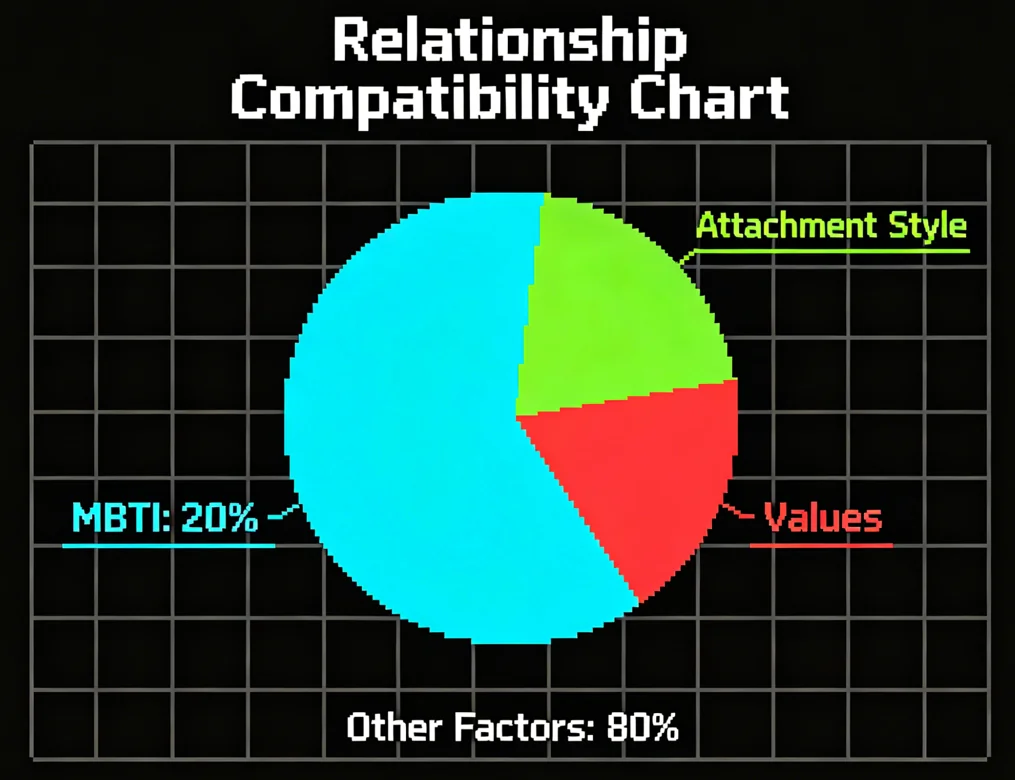
Layer 1 — MBTI: How You Communicate (20% of the Equation)
Your MBTI type tells you about communication preferences—not love destinies. An INTJ doesn't 'need' an ENFP to be happy. An ISTJ isn't 'doomed' with an ENTP. What your type does tell you is how you naturally express yourself, process information, and make decisions.
Here's a quick reference for how the four temperament groups tend to pair:
Analysts (NT types — INTJ, INTP, ENTJ, ENTP): Intellectual stimulation and autonomy are non-negotiable. They often find their depth matched by other NTs and NFs—though partners who need more emotional explicitness can feel like they're talking to a wall.
Diplomats (NF types — INFJ, INFP, ENFJ, ENFP): Emotional authenticity is oxygen. The 'you complete me' pull toward NTs is real, but it comes with a risk: feeling chronically unseen when your partner defaults to logic-first.
Sentinels (SJ types — ISTJ, ISFJ, ESTJ, ESFJ): Stability isn't boring—it's the foundation. Other SJs and grounded SPs make natural partners, but throw in chronic unpredictability and you'll see an SJ suffocate.
Explorers (SP types — ISTP, ISFP, ESTP, ESFP): Freedom and present-moment experience above all. Fellow SPs and stabilizing SJs work well, but extensive planning and structure? That's their kryptonite.
Notice the pattern? 'Tends to' and 'can'—not 'must' and 'will.' These are tendencies, not laws. The MBTI love compatibility chart gives you probabilities, not prophecies.
Layer 2 — Attachment Style: How You Feel Safe (The Real Game-Changer)
If you want me to bet on a couple's future, don't show me their MBTI types. Show me their attachment styles.
Research tracking over 3,000 couples consistently shows that attachment security predicts relationship success with over 90% accuracy—a finding that dwarfs anything personality typing has produced (Mikulincer & Shaver, 2019; Gottman Institute). Your attachment style—formed primarily in early childhood—governs how you experience trust, handle conflict, and seek (or avoid) closeness.
The four attachment styles in a nutshell:
Secure (roughly 50% of adults): You're comfortable with intimacy and independence. You trust your partner, communicate needs directly, and repair conflicts effectively.
Anxious (roughly 20%): You crave closeness but fear abandonment. Small conflicts feel like existential threats. You might over-text, over-check, or over-accommodate.
Avoidant (roughly 25%): You value independence to the point of discomfort with intimacy. Emotional conversations feel like traps. You might shut down, pull away, or 'need space' during conflict.
Fearful (roughly 5%): You want closeness and fear it simultaneously—push-pull dynamics that can feel exhausting for both partners.
Here's why this matters more than MBTI: two securely attached people of any personality combination can build a thriving relationship. Two insecurely attached people—even a textbook 'golden pair'—will struggle. Attachment style is the operating system. MBTI is the user interface.
MBTI describes cognitive processing preferences — how you take in information, make decisions, and orient toward the world. It doesn't describe what happens to your nervous system when someone you love seems distant. The E/I dimension says something about where you direct your energy. It says almost nothing about whether you're comfortable with emotional dependence. The F/T dimension describes how you prefer to make decisions. A Feeling-dominant type can be avoidantly attached; a Thinking-dominant type can be anxiously attached. The decision-making preference and the relational coping strategy are independent variables.
What this means practically: MBTI type tells you a great deal about how someone thinks. It tells you relatively little about how they love — specifically, how they behave when attachment needs feel threatened.
How Attachment Patterns Show Up Differently Across MBTI Types
The interesting territory is when you look at how the same attachment style expresses differently through different cognitive function stacks. Same attachment style. Completely different presentations depending on MBTI type.
Anxious Attachment Across Types
An ENFJ with anxious attachment uses Fe — extraverted Feeling — as the primary vehicle for attachment anxiety. Their bids for reassurance tend to look like emotional attunement: checking in frequently, reading the room for signs of tension, adjusting their behavior to manage the perceived emotional climate. The anxiety is relational and interpersonal.An INTJ with anxious attachment uses Ni — introverted Intuition — to construct elaborate predictions about where the relationship is heading. Their anxiety tends to show up as long-range worry rather than immediate reactiveness: not "why haven't you texted me back," but a persistent sense that the relationship's trajectory is moving toward a predictable bad ending. They may withdraw preemptively to avoid a loss they've already modeled.
An ESFP with anxious attachment uses Se — extraverted Sensing — to stay intensely present to every real-time signal from a partner. Their anxiety lives in the moment: the slight change in tone, the pause before an answer, the facial expression that might mean something. They're extraordinarily attuned to immediate sensory-social cues and can misread them under stress.
Avoidant Attachment Across Types
An ISFP with avoidant attachment uses Fi — introverted Feeling — to frame emotional self-sufficiency as a value rather than a defense. Their independence feels authentic and principled, not like a strategy for managing intimacy anxiety. Getting close feels like a threat to the self rather than a threat from the other person.An ENTJ with avoidant attachment uses Te — extraverted Thinking — to substitute achievement and external results for emotional connection. They're not cold; they're redirected. The energy that an anxiously attached person would put into monitoring a partner's emotional state goes into building, optimizing, and controlling the external environment.
An INFP with avoidant attachment is less common but distinctive: they often have rich internal emotional landscapes (Fi-dominant) while simultaneously finding real-world intimacy to be a diminishment of the ideal relationship that exists in their imagination. Real people disappoint; the version in their head doesn't.
Fearful-Avoidant (Disorganized) Attachment
This combination tends to be particularly visible in types with strong Feeling functions, because the internal conflict — wanting closeness and fearing it simultaneously — plays out through the same cognitive channel used for emotional processing. An INFJ with fearful-avoidant attachment uses Ni/Fe to build intricate narratives about why the relationship is both deeply meaningful and probably going to end badly. The Fe that normally produces warmth and attunement is hijacked by the attachment anxiety; they can read a partner's emotional state with extraordinary accuracy and use that accuracy to anticipate rejection rather than connection.Understanding these differences matters because the same attachment behavior can look completely different depending on the MBTI type — and misreading it leads to misdiagnosis. A Thinking-dominant + avoidant attachment pattern is easy to misread as typical T-type emotional restraint. The avoidance isn't a cognitive preference; it's a regulatory strategy. A Feeling-dominant + anxious attachment pattern is easy to misread as typical F-type emotional expressiveness. What looks like caring attentiveness may be anxiety-driven monitoring.
Can Attachment Style Change? What That Means for Compatibility
One of the questions that matters most for long-term compatibility is whether insecure patterns are fixed or movable. The research is actually encouraging. Attachment style isn't destiny. Studies tracking adults over time show that significant positive relationship experiences — with a romantic partner, a therapist, or even a close friend — can shift insecure patterns toward security. The term researchers use is "earned security": people who didn't have a secure foundation in childhood but developed one through subsequent relational experience.
What this means in practice: someone who tests as anxiously or avoidantly attached at 22 isn't necessarily going to have the same pattern at 35. Consistent experience of a partner who is predictably available, doesn't punish vulnerability, and communicates directly can gradually reshape the internal working model.
The complicating factor: this shift takes time — often years — and requires the insecurely attached person to be exposed to genuinely different experiences rather than relationships that confirm the existing model. An anxiously attached person who chooses a string of avoidant partners doesn't get the data they need to update their template. The pattern self-perpetuates.
For compatibility, this is both a caution and an opening. The caution: don't assume that love alone will resolve an insecure partner's patterns. It usually won't, and the effort required can drain the person trying to provide the "corrective experience." The opening: people genuinely do change, and two people who understand their patterns and want to shift them have better odds than the average couple who's just hoping things work out.
Practical compatibility questions to ask: Who de-escalates in conflict? Where does each person's shadow show up under attachment threat? What does each person's secure mode look like? Are the patterns moving in the same direction? A relationship where one person is actively working to shift their patterns and the other isn't creates asymmetry that tends to become resentment over time.
Your MBTI tells you the form your relational behavior takes — the specific way you process emotions, communicate under stress, and restore equilibrium. Your attachment style tells you the driver — the underlying anxiety or security that shapes whether your natural cognitive preferences serve connection or undermine it. Working with this means developing enough self-awareness to notice when your cognitive preferences are serving connection versus when they're being co-opted by attachment anxiety.
Layer 3 — Shared Values: How You Build a Future (The Foundation)
Personality compatibility without shared values is a Ferrari with no steering wheel—fast, but going nowhere together. When MBTI love compatibility charts tell you nothing about money, kids, or purpose—you need this layer.
Values are the non-negotiables. The stuff that doesn't show up in any personality test but determines whether you're actually building a life together or just sharing a really long weekend. If you've already explored how your cognitive styles and emotional patterns align, moon phase compatibility adds another dimension—how your inner emotional rhythms sync.
Five questions to align on early (not after moving in together):
Money: What's your relationship with debt, spending, and financial risk? Do you save for tomorrow or spend for today?
Family: Do you want kids? If so, how do you want to raise them? What role do extended families play in your life?
Growth: Do you expect the relationship to stay comfortable, or do you want a partner who pushes you to evolve?
Autonomy: How much independence do you need? What counts as 'too much' time apart—or together?
Meaning: What gives your life purpose, and does your partner respect and support that thing—even if it's different from theirs?
You can be an INFP married to an ESTJ and be deliriously happy if you share core values. You can be the most 'compatible' MBTI pair on paper and be miserable if one of you wants three kids in the suburbs and the other wants to be child-free and nomadic.
What the Research Actually Says About MBTI and Relationships
Let's look past the viral charts and Instagram infographics. What does the actual data say about personality type and relationship outcomes?
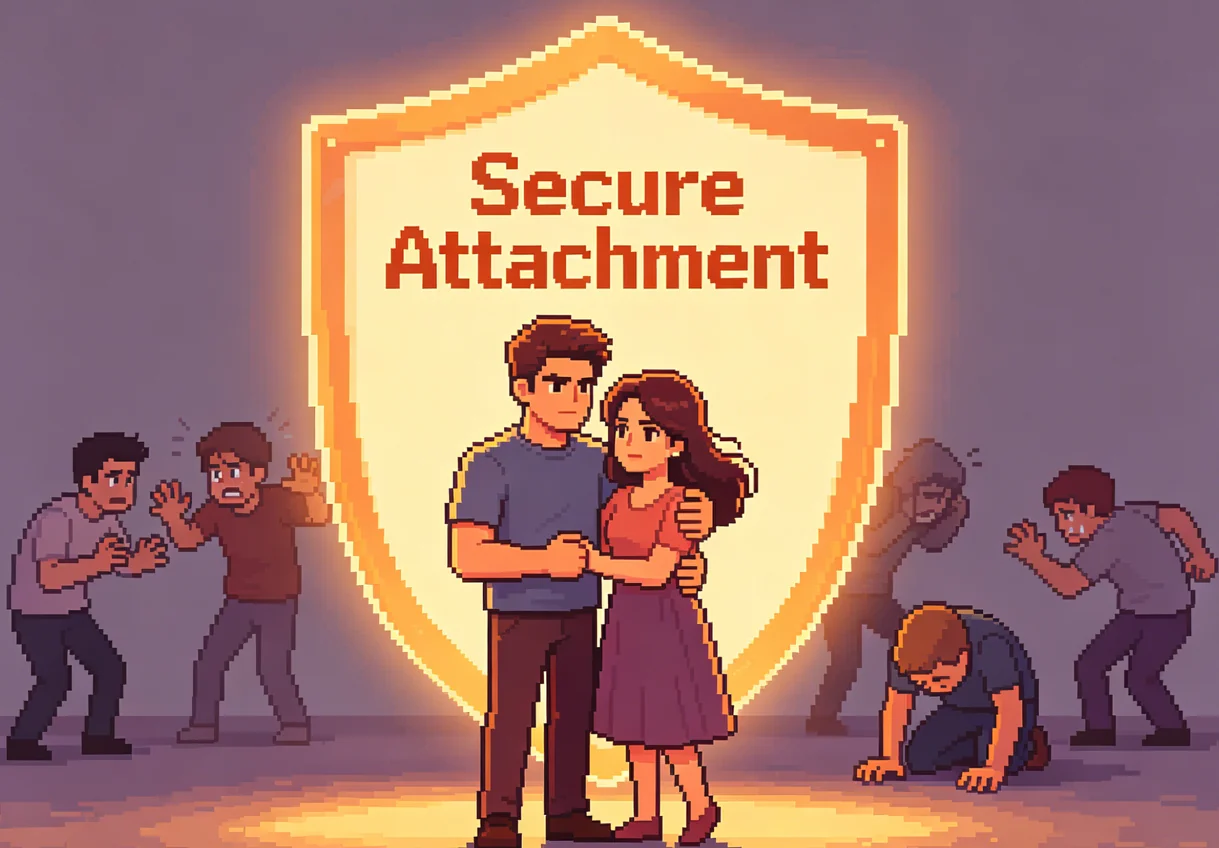
The Similarity vs. Complementarity Debate, Settled
'Opposites attract' is one of the most persistent myths in the MBTI dating compatibility world. It's also one of the least supported by evidence.
A comprehensive 2023 scoping review published in the Journal of Social and Personal Relationships examined 339 studies on similarity in romantic relationships and found that actual similarity had limited predictive power for long-term relationship outcomes—but where it did matter, similarity won over complementarity every time (Sprecher et al., 2025). The 2009 meta-analysis of 460 effect sizes across 313 studies by Montoya and Horton reached a similar conclusion: perceived similarity predicted attraction, but actual complementarity didn't predict lasting satisfaction.
The most counterintuitive finding? The pairings that look most exciting on paper—opposite types with complementary functions—are often the ones that crack first under sustained stress. That initial spark of difference? It becomes the same friction that erodes the relationship when life gets hard. The ENFP who found the ISTJ's stability 'grounding' at month three experiences it as 'controlling' at year three. The ISTJ who admired the ENFP's spontaneity now calls it 'irresponsibility.'
Similarity doesn't guarantee happiness—but it does reduce the number of inherent friction points you'll face. And over a lifetime together, that matters more than most people want to admit.
Why Two 'Perfect Matches' Can Still Break Up
Marcus and Priya were the couple everyone envied. Both INFJs. They finished each other's sentences, shared the same values, and had one of those connections that felt almost telepathic. Their MBTI compatibility chart lit up green across the board. Two years in, Marcus had an emotional affair. Priya was devastated.
What went wrong? Both had high neuroticism scores—something their MBTI results didn't capture. Marcus's anxiety went unaddressed because 'we understand each other so well' became a substitute for actually talking about his struggles. Priya's perfectionism created a household where vulnerability felt dangerous, because both of them were too busy being the 'perfect couple' to admit when things weren't working.

Emotional stability matters more than any four-letter combination. A 2024 study tracking couples in 20+ year relationships found that neuroticism, extraversion, and conscientiousness were the strongest personality predictors of relationship endurance—not MBTI type matching. Two emotionally stable people with 'low' compatibility will outperform two emotionally volatile people with 'perfect' compatibility. Every time.
Same-Type Relationships: Deep Connection or Shared Blind Spots?
Dating someone with the same MBTI type feels like looking in a mirror—at first. You 'get' each other instantly. There's no translation layer. No explaining why you need alone time (if you're both introverts) or why you hate rigid plans (if you're both perceivers).
But that deep understanding can become a trap. What feels like 'finally being seen' is sometimes just both people projecting their inner world onto the other. You're not understanding them—you're recognizing yourself and calling it connection.
Take two INFPs in a relationship. Both are idealistic, both avoid conflict, both dream big and struggle with follow-through. The shared idealism creates a beautiful bubble—until a real-world decision needs to be made. Neither wants to take the lead. Neither wants to crush the other's vision. Decisions get deferred indefinitely. Resentment builds silently. The relationship slowly drowns in unspoken compromises and mutually reinforced indecision.
Or two ESTJs—both decisive, both structured, both convinced their way is right. When they agree, it's a power couple. When they disagree, it's a standoff with no natural mediator. Neither is wired to back down or seek emotional common ground first.
Same-type relationships aren't doomed. But they do require extra awareness of shared blind spots. The thing you both struggle with? No one's going to compensate for it. The thing you both avoid? It's staying avoided.
So You Got Your MBTI Compatibility Score—Now What?
The test is done. The score is staring at you. Here's how to actually use it.
If Your Score Is High: Don't Get Complacent
A high compatibility score is like a great first impression—it's an advantage, not a guarantee. Here are the three traps high-match couples fall into most often:
1. Assuming understanding equals effort: 'We're so compatible, we shouldn't have to work at this.' Compatibility reduces friction; it doesn't eliminate it. High-match couples often skip the communication skills that lower-match couples are forced to develop—and then get blindsided when a real conflict hits.
2. Confusing comfort with growth: Similar types create comfort zones. Comfort zones become ruts. If you never have to stretch to understand your partner, you might stop growing altogether.
3. Ignoring the 80%: You nailed the 20% that MBTI measures. What about attachment style, shared values, emotional regulation, conflict resolution skills? High MBTI compatibility can mask deep incompatibilities in the layers that matter more.
Your action checklist:
Discuss your attachment styles together (use the 5 questions above)
Identify one shared blind spot you both have—and make a plan for it
Schedule a quarterly 'relationship review' where you check in on values alignment, not just vibe alignment
Learn one conflict resolution framework (Gottman's 'soft startup' is a great starting point)
If Your Score Is Low: Don't Panic
A low MBTI compatibility score doesn't mean you're doomed. It means you'll need to be more intentional—and that intentionality can actually make your relationship stronger than couples who coasted on natural compatibility.
Jin and Soo had one of the 'worst' MBTI matches on paper—an ESTJ/ENFP pairing that every chart marked red. But they'd been together for seven years and described their relationship as the best thing in their lives. Their secret? 'We never assumed we'd just understand each other,' Jin told me. 'From day one, we had to explain ourselves. It felt tedious at first, but it forced us to actually listen. Our friends in 'perfect match' relationships are the ones who never learned to communicate because they thought they didn't have to.'
Four strategies for low-match couples:
1. Build a translation manual: Create a shared document where you each explain what your preferences mean in practice. 'When I say I need space, it means 30 minutes, not 30 days.' 'When I ask 'are you okay?', I'm not interrogating you—I'm checking in.'
2. Schedule the hard conversations: Don't wait for differences to become conflicts. Proactively discuss how you handle money, planning, social energy, and emotional processing.
3. Celebrate the stretch: Your partner's different perspective isn't a problem to solve—it's a growth opportunity. The J who learns spontaneity and the P who learns structure both become more resilient humans.
4. Get professional support early: Couples therapy and attachment-focused approaches have their own evidence base, but this evidence should not be presented as an MBTI-specific 85% versus 35% improvement rate.
The Conversation Starter Framework
MBTI isn't a filter. It's a vocabulary—a shared language for talking about differences that would otherwise feel mysterious and personal. Use your results to start conversations, not to end them.
Five questions to ask each other after you both take the test:
'What's one thing about your type that you wish I understood better?'
'When we disagree, how does your type show up? Do you need to talk it out, think it through, or take space first?'
'What's a situation where our type difference caused a misunderstanding—and how would you want to handle it differently next time?'
'Is there a way I've been interpreting your behavior through my type's lens instead of yours?'
'What's one thing our types share that you're grateful for?'
These questions work whether your compatibility score is 95% or 15%. The point isn't the score—it's the conversation the score makes possible.
When MBTI Compatibility Becomes a Red Flag
There's a dark side to the MBTI compatibility obsession, and it's getting worse as personality typing becomes the default filter on dating apps. Bumble's zodiac badge is the platform's most-used filter globally—and if you're curious how astrological patterns interact with personality, try our zodiac compatibility test. Imagine what happens when MBTI gets the same treatment. (Tinder already saw a 30% increase in time spent on the app after introducing personality test features.) When millions of people start treating a four-letter code as a relationship qualification, something's gone sideways.
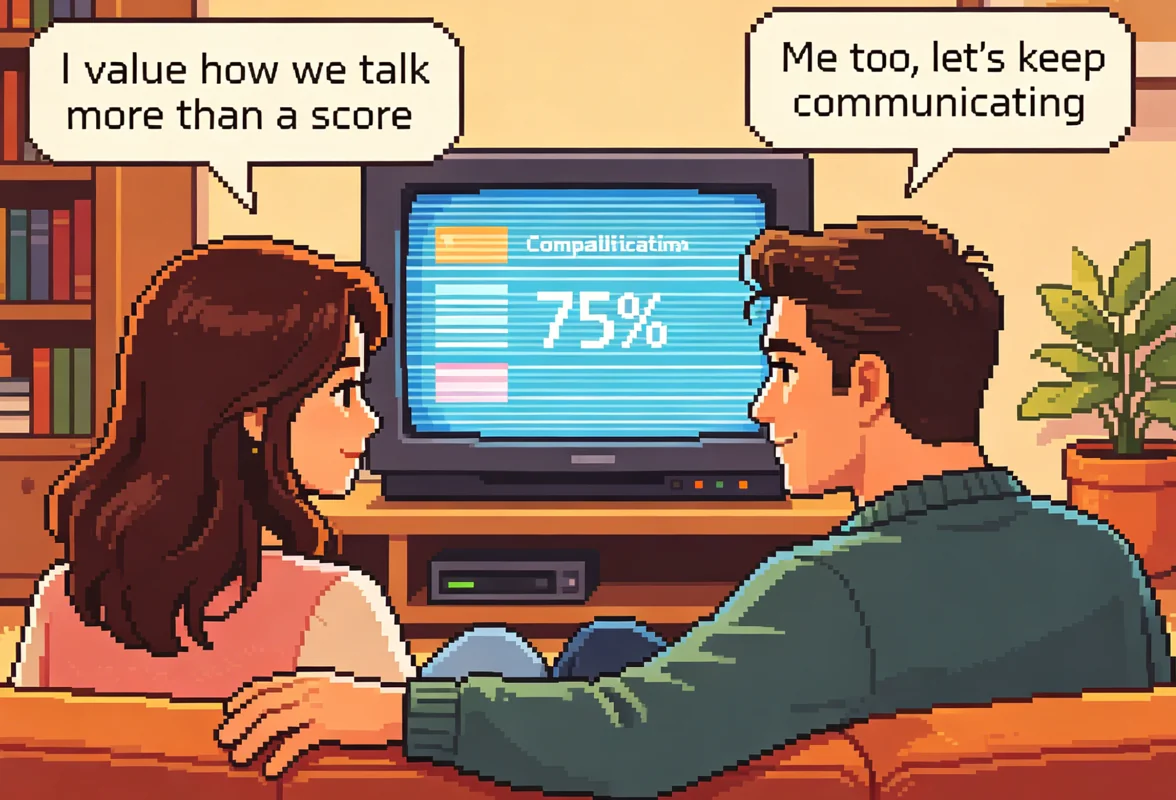
Using Personality Type as an Excuse for Bad Behavior
'I'm an INTJ—I'm just blunt.' 'I'm an ENFP—I can't help being flaky.' 'I'm an ISTP—I'm not built for emotional conversations.'
No. Your personality type describes your natural preferences. It does not exempt you from basic human accountability. When someone uses MBTI to justify harmful behavior—dismissiveness, unreliability, emotional unavailability—that's not self-awareness. That's weaponized personality theory.
The difference between self-understanding and self-excuse comes down to one question: Are you explaining your behavior to help your partner understand you, or to get them to stop asking you to change? The first builds intimacy. The second builds resentment.
The Danger of Self-Fulfilling Prophecies
Here's how the cycle works: you see a 'low match' score and start paying more attention to how you're different. Small frustrations you'd normally brush off now feel like 'evidence' of incompatibility. Your partner's quiet evening becomes 'emotional distance' instead of 'normal introvert recharge time.' You start interpreting everything through the lens of 'we don't match.' The relationship deteriorates—not because you were incompatible, but because you believed you were.
This is the psychological equivalent of a bank run. The bank is fine until everyone decides it's not and withdraws their money all at once. The relationship was fine until you started treating a test score like a crystal ball and withdrew your emotional investment accordingly.
When to Look Beyond Personality Tests
Personality tests are tools for self-understanding, not substitutes for professional help. If you notice any of these three patterns, it's time to stop Googling compatibility charts and start talking to someone qualified:
1. You keep having the same fight: If you and your partner are stuck in a loop—same argument, same triggers, same unresolved ending—no personality compatibility test will break that cycle. That's a conflict pattern, not a personality mismatch.
2. You feel unsafe: Emotional, verbal, or physical abuse is not a 'type difference.' It's abuse. No compatibility score justifies staying in a harmful situation.
3. You're using tests to avoid the real issue: If you've taken five different personality tests this month but haven't had one honest conversation with your partner about what's actually bothering you, the tests have become a distraction, not a tool.
Try All 4 Compatibility Tests on Compatibility.work
MBTI is just one lens—and no single lens gives you the full picture. That's why compatibility.work offers four complementary tests, each measuring a different dimension of connection:
MBTI compatibility test: Your communication preferences—how you process, decide, and express. The cognitive layer.
Zodiac compatibility test: Your energetic patterns—how your elemental natures interact. The instinctive layer.
Moon Phase compatibility test: Your emotional rhythms—how your inner cycles sync (or clash). The feeling layer.
SBTI compatibility test: A playful twist on the classic—because sometimes the most accurate insight comes from the angle you didn't expect. The wildcard layer.
Each test takes under five minutes. Together, they give you a multi-dimensional view of compatibility that no single framework can match. Think of it as getting a second, third, and fourth opinion instead of betting your relationship on one diagnosis.
FAQ: Your MBTI Compatibility Questions, Answered
How accurate is the MBTI compatibility test?
Somewhere between 'useful' and 'not the whole story.' Meta-analyses put the correlation at r < 0.3 with relationship satisfaction—real patterns, but only a fraction of the picture. The test is accurate at measuring what it measures (communication style alignment). It's inaccurate the moment you treat it as a relationship crystal ball.
Can MBTI 'incompatible' types still have a great relationship?
Absolutely—and many do. MBTI compatibility measures default communication alignment, not relationship potential. Two people with 'low' MBTI compatibility who are securely attached, share core values, and have strong conflict resolution skills will consistently outperform a 'golden pair' who lack those foundations. The MBTI dating compatibility charts show probabilities, not certainties.
Should I put my MBTI type on my dating profile?
Depends on what you're using it for. Conversation starter? Great. Bouncer at the door? You're screening out people you might actually click with. In South Korea, nearly 90% of young adults have taken the MBTI and listing your type is standard—but even Korean relationship coaches say: don't make it a dealbreaker.
What's more important—MBTI compatibility or attachment style?
Attachment style. The research isn't even close. Attachment security predicts relationship success with over 90% accuracy based on studies tracking 3,000+ couples, while MBTI type matching hovers around 15–20% above chance. MBTI tells you how someone communicates; attachment style tells you whether they can stay emotionally present when things get hard. The latter matters more.
Can my MBTI type change over time?
Your core preferences tend to stay stable, but you can absolutely develop your non-preferred functions over time—especially in response to life experiences, relationships, and intentional growth. An introvert who's developed strong social skills hasn't become an extravert; they've just become a more versatile introvert. Some people do report different test results at different life stages, which may reflect situational adaptation rather than a fundamental type shift. Curious how a different framework might see you? The SBTI compatibility test offers a playful twist that sometimes reveals what MBTI misses.
What is MBTI love compatibility?
MBTI love compatibility looks at how your personality type interacts with your partner's in romantic contexts—everything from how you express affection to how you handle conflict and make decisions together. It's the romantic spin on general MBTI compatibility, and while the MBTI love compatibility chart can highlight where you'll naturally click and where you'll need to work harder, remember: it's measuring communication style, not whether you'll actually fall in love. Two 'incompatible' types with shared values and secure attachment will outlove a 'perfect match' every time.
The Bottom Line
Your MBTI compatibility score tells you something real—about how you and your partner naturally communicate, where friction is likely, and what adjustments you might need to make. But it's 20% of the story. Attachment style determines whether you can stay connected through conflict. Shared values determine whether you're heading in the same direction. And emotional stability—the thing MBTI doesn't measure at all—might be the single most important factor of all.
Don't throw out the test. Just put it in its proper place: one tool among several, not the final word. Use it to ask better questions, not to arrive at premature answers.
Take the free MBTI compatibility test → and then explore our other personality and compatibility tools to get a broader picture. Your relationship deserves more than one lens.