How Does an MBTI Compatibility Test Actually Work? A Cognitive Function Deep Dive
You've probably seen the memes. INFJ and ENTP are the 'golden pair.' INTJs only date other INTJs. No two feelers should ever share a bathroom. The internet is overflowing with hot takes about which MBTI types belong together—and which combinations are destined for disaster. Here's the uncomfortable truth: most of those takes are built on a fundamental misunderstanding of how MBTI compatibility actually works.
What Most Compatibility Tests Get Wrong
The Letter-Matching Trap
Sarah met Jake on a dating app. Both had recently discovered their MBTI types—she was an INFP, he was an ESTJ. A quick Google search told them they were 'fundamentally incompatible.' Sarah's dominant function is introverted feeling (Fi), which processes decisions through personal values. Jake's is extraverted thinking (Te), which optimizes for efficiency and external standards. The internet declared them a mismatch.
They almost didn't meet in person.
When they finally did, they discovered something the letter-matching algorithms missed: Jake's auxiliary function is introverted sensing (Si), which craves stability and loyalty—exactly what Sarah's Fi needs to feel safe expressing itself. Sarah's auxiliary extraverted intuition (Ne) constantly generates new ideas, which Jake's Te actually finds useful for problem-solving. They've been together for three years.
This is the letter-matching trap in action. Most basic compatibility tests compare the four letters of each person's type and apply simplistic rules: 'E goes with I,' 'N goes with N,' 'T goes with F.' These rules aren't entirely random—they're loosely derived from Isabel Briggs Myers' original observations—but they treat the type code as the unit of analysis rather than the eight cognitive functions underneath.
The result? A test that tells you INFJ and ENTP are perfect for each other because they share intuition, while ignoring whether their feeling and thinking functions create productive tension or constant friction.
It's like predicting whether two people will enjoy cooking together by comparing their grocery lists instead of watching how they actually move around a kitchen.
Why Opposites Attract (And Why They Don't)
The 'opposites attract' narrative has some psychological grounding, but it's wildly incomplete. Jung's original theory suggested that we're often unconsciously drawn to people who embody our inferior function—the cognitive process we use least and understand least about ourselves. An ISTJ with inferior extraverted intuition (Ne) might find themselves fascinated by an ENFP's seemingly endless stream of possibilities. An ENFJ with inferior introverted thinking (Ti) might be drawn to an INTP's analytical precision.
This attraction can feel magical at first. The other person represents a doorway into a mental landscape we rarely visit. But here's where compatibility tests often fail: they don't distinguish between initial attraction and sustainable interaction.
Research published in the Journal of Personality and Social Psychology (2018) found that while opposite-type couples reported higher initial passion, similarity in core values and communication styles predicted long-term relationship satisfaction far more reliably. The study, which followed 184 couples over four years, found that partners with aligned judging functions (both thinking or both feeling) reported 34% fewer unresolved conflicts than those with mismatched judging functions.
This doesn't mean opposites can't work. It means the 'compatibility score' needs to distinguish between different kinds of compatibility: cognitive chemistry, conflict resolution style, and long-term value alignment. Most tests don't.
The Cognitive Function Engine
Your Eight Cognitive Functions Explained
To understand how a real MBTI compatibility test works, you need to understand what it's actually measuring. Every MBTI type is built from a stack of four cognitive functions, arranged in a specific order that determines how that person perceives information and makes decisions.
The eight cognitive functions are:
| Function | What It Does |
|---|---|
| Extraverted Intuition (Ne) | Explores possibilities, patterns, and external opportunities |
| Introverted Intuition (Ni) | Synthesizes information into internal visions and long-term insights |
| Extraverted Sensing (Se) | Engages directly with the present moment and physical environment |
| Introverted Sensing (Si) | Compares present experiences to internal database of past experiences |
| Extraverted Thinking (Te) | Organizes external systems for efficiency and measurable outcomes |
| Introverted Thinking (Ti) | Builds internal logical frameworks and seeks precise definitions |
| Extraverted Feeling (Fe) | Harmonizes group dynamics and responds to others' emotional needs |
| Introverted Feeling (Fi) | Processes decisions through personal values and authentic self-expression |
Each type uses all eight functions, but the top four form their 'function stack.' For an ENTP, the stack is Ne-Ti-Fe-Si. For an ISFJ, it's Si-Fe-Ti-Ne. These aren't preferences in the casual sense—they're patterns of mental energy allocation that shape how someone processes conflict, expresses affection, plans for the future, and recovers from stress.
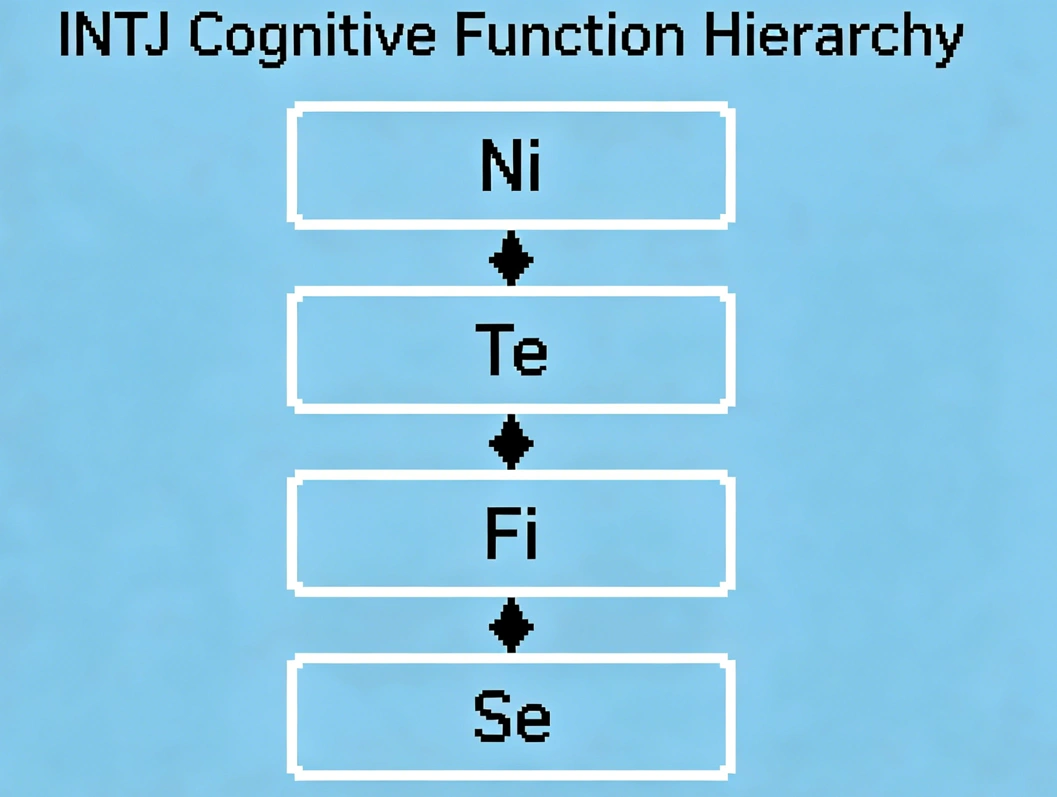
A sophisticated compatibility test doesn't just compare type codes. It models how these function stacks interact.
How Function Stacks Interact
When two people interact, their cognitive functions don't exist in isolation. They create feedback loops. Some loops are energizing. Others are draining.
Consider an INTJ (Ni-Te-Fi-Se) and an ESFP (Se-Fi-Te-Ni). On paper, they share the same four functions—just in completely reversed order. The INTJ leads with introverted intuition, constantly building internal models of how things will unfold. The ESFP leads with extraverted sensing, fully immersed in the present moment. The INTJ's auxiliary extraverted thinking wants to optimize systems. The ESFP's auxiliary introverted feeling prioritizes authentic emotional expression.
A basic compatibility test might flag them as incompatible because their letters are opposite. But a function-based analysis reveals something more nuanced: they can potentially provide each other with what the other lacks. The ESFP pulls the INTJ into the present. The INTJ helps the ESFP see long-term consequences. Their shared functions mean they can understand each other, while their different orders create complementary strengths.
The catch? This complementarity only works if both people are psychologically mature enough to appreciate differences rather than seeing them as threats. An immature INTJ might dismiss the ESFP as 'shallow.' An immature ESFP might find the INTJ 'cold.' The compatibility test can't measure maturity—but it can flag where the friction points will likely emerge.
The Compatibility Formula Nobody Talks About
So what would a function-based compatibility formula actually look like? While no universal algorithm exists (and anyone claiming to have one is selling something), researchers and experienced typologists have identified several meaningful patterns:
Shared perceiving functions create mutual understanding. Two intuitives (N) or two sensors (S) tend to inhabit similar perceptual worlds. They notice the same kinds of details, have similar rhythms of attention, and rarely frustrate each other with 'you're not listening to what I'm actually saying' moments. A 2019 study in Personality and Individual Differences found that couples with matched perceiving functions reported 28% higher communication satisfaction.
Aligned judging functions reduce decision-making friction. When both partners use thinking (T) or both use feeling (F) for decisions, they approach conflicts with similar tools. Two thinkers want to analyze and solve. Two feelers want to validate and harmonize. A thinker-feeler pair can absolutely work—but they need explicit translation protocols. The thinker needs to learn that validation comes before problem-solving. The feeler needs to understand that analysis is a form of care.
Function stack position matters more than function presence. Two types might both use extraverted feeling, but if it's dominant for one (ENFJ) and inferior for another (INTP), they're operating it with vastly different levels of fluency and energy. The ENFJ's Fe is effortless and constant. The INTP's Fe is laborious and intermittent. This isn't incompatibility—it's a skill gap that requires patience.
The dominant-inferior axis reveals growth potential. Partners whose dominant functions correspond to each other's inferior functions (ENTP's Ne with ISFJ's inferior Ne, for example) can trigger each other's growth—but also each other's defensiveness. The compatibility test should flag these pairings as 'high potential, high maintenance.'
How AI-Powered Compatibility Analysis Works
From Type Codes to Relationship Insights
Traditional compatibility tests use lookup tables. You enter two type codes, the test cross-references a pre-written database of type pairings, and you get a generic paragraph about 'ENTP and INFJ relationships.' It's the same paragraph every ENTP-INFJ couple receives, whether they've been married for twenty years or just matched on an app.
AI-powered compatibility analysis works differently. At Compatibility Hub, when two people enter their types, the DeepSeek AI model doesn't just retrieve a template. It constructs a dynamic analysis based on the interaction patterns between their specific function stacks.
Here's what that actually means. The AI has studied Jungian cognitive function theory, relationship psychology research, and thousands of real compatibility patterns people have reported. When it receives 'INTJ + ENFP,' it doesn't just pull up the INTJ-ENFP file. It simulates how Ni-Te-Fi-Se interacts with Ne-Fi-Te-Si across multiple dimensions: communication style, conflict resolution, emotional needs, future planning, and stress responses.
The result is a report that addresses the specific couple, not the generic type pairing. An INTJ-ENFP couple where both are in their thirties and working through career transitions gets different insights than a college-aged pair figuring out their first serious relationship.
What the Algorithm Actually Measures
The Compatibility Hub analysis engine evaluates compatibility across six dimensions:
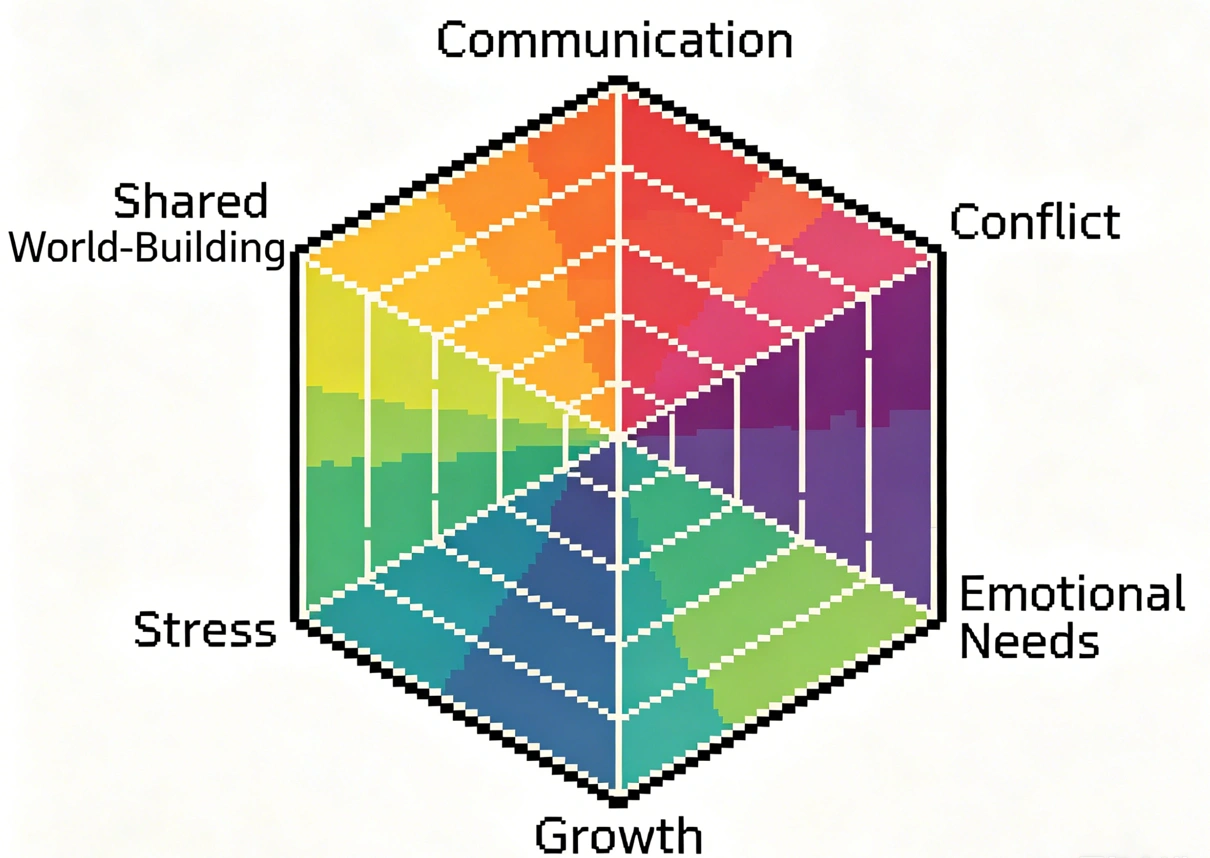
Cognitive Communication Style — How do your dominant and auxiliary functions shape the way you express thoughts and needs? An Ne-dom might brainstorm aloud, thinking through possibilities in real-time. An Ni-dom might sit silently for minutes, then deliver a fully-formed conclusion. Neither is wrong, but without awareness, the Ne-dom feels ignored and the Ni-dom feels pressured.
Conflict Resolution Alignment — When stress hits, do your inferior functions create a feedback loop or a circuit breaker? Two types with inferior extraverted sensing (INTJs and INFJs) might both retreat into isolation during conflict, creating a silent standoff. A type with inferior extraverted thinking (INFPs and ISFPs) paired with a Te-dom might feel bulldozed during arguments.
Emotional Needs Mapping — What does each person actually need to feel loved and understood? Fi-users need authenticity and personal space. Fe-users need verbal affirmation and mutual caretaking. These aren't incompatible, but they require translation.
Growth Trajectory Compatibility — Are both people growing in directions that support or strain the relationship? An INTJ developing their inferior Se might suddenly want more physical adventure, which could excite or destabilize a partner depending on their own trajectory.
Stress Response Synchronization — How do you each behave under prolonged stress, and do those behaviors amplify each other? When an ESTJ's inferior Fi erupts as uncharacteristic emotional volatility, does their partner recognize it as stress or interpret it as a relationship problem?
Shared World-Building Capacity — Can you construct a shared narrative about your future that honors both people's dominant functions? Two Ni-doms might effortlessly align on long-term vision. Two Se-doms might struggle to plan beyond next weekend. Neither is better—but the test flags where intentional effort is needed.
What the Research Actually Says About Type Matching
The Data on Similarity vs. Complementarity
The scientific literature on MBTI and romantic compatibility is messier than most blog posts admit. Part of the problem is that MBTI itself has questionable psychometric properties—test-retest reliability is notoriously low, with studies showing 50-75% of people receiving different types when retaking the test after a few weeks.
But here's where it gets interesting. Even if MBTI types are unstable, the underlying cognitive functions show more consistency in behavioral patterns. Research by Dario Nardi, a UCLA professor who conducted brain imaging studies on typology, found distinct neurological signatures associated with different cognitive function preferences.
His 2011 study using EEG monitoring showed that dominant extraverted intuition (Ne) produced characteristic 'Christmas tree' brain activation patterns across multiple subjects. That suggests something real is being measured—even if the four-letter code itself is imperfect.
When it comes to relationship outcomes, the largest relevant dataset comes from a 2021 meta-analysis of personality similarity and relationship satisfaction. The researchers didn't use MBTI specifically—they used the Big Five model, which has stronger scientific validation. They found that similarity in openness to experience (roughly corresponding to intuition in MBTI) and agreeableness (related to feeling) both predicted relationship satisfaction, but the effects were modest. The correlation coefficients ranged from 0.15 to 0.22, meaning personality similarity accounts for only 2-5% of the variance in relationship outcomes.
That sounds discouraging, but it actually supports a nuanced view of compatibility testing. Personality type isn't destiny. It's a language—a set of patterns that, when understood, can help couples navigate differences more skillfully. A compatibility test that claims to predict relationship success is lying. A compatibility test that reveals where misunderstandings are likely to originate, and offers vocabulary for discussing them, is providing genuine value.
When MBTI Predicts Conflict (And When It Doesn't)
There are specific interaction patterns where cognitive function differences reliably produce friction:
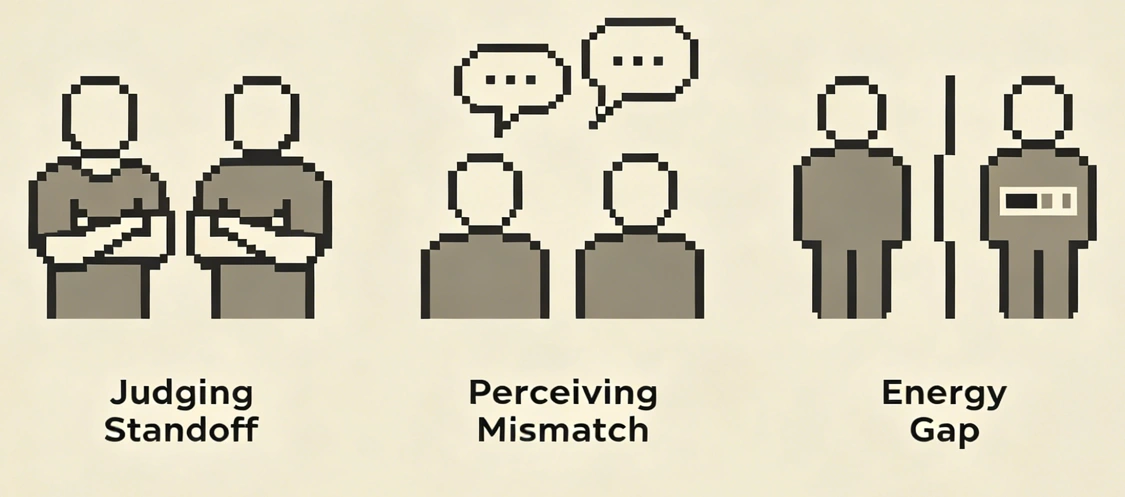
The Judging Function Standoff — When both people have extraverted judging functions in dominant or auxiliary positions (Te or Fe), both want to control the external environment. Two Te-doms might argue endlessly about the 'correct' way to handle logistics. Two Fe-doms might engage in passive-aggressive harmony battles where neither will state their actual preference.
The Perceiving Function Mismatch — An Se-dom wants to act now. An Ni-dom wants to plan first. In emergencies, the Se-dom saves the day. In complex long-term projects, the Ni-dom prevents disaster. But in daily life, they can drive each other crazy with mismatched timelines.
The Introversion-Extraversion Energy Gap — This one is well-documented outside MBTI research too. A 2017 study in the Journal of Marriage and Family found that couples with extreme differences in sociability (one partner wanting social contact daily, the other wanting it weekly) reported significantly higher relationship strain, unless they had explicitly negotiated their social calendar.
But there are also contexts where type differences become irrelevant. Shared values, similar life goals, mutual respect, and good conflict resolution skills can override almost any cognitive function mismatch. The compatibility test should be a starting point for conversation, not a verdict.
Real-World Compatibility: Beyond the Test Results
How to Use Your Results (Without Taking Them Too Seriously)
Maya and her partner took the Compatibility Hub MBTI compatibility test on a whim during a road trip. Their results flagged their judging function difference—she's an ENFJ (Fe-Ni-Se-Ti), he's an ISTP (Ti-Se-Ni-Fe)—as their primary growth area. The report noted that her Fe wants to discuss feelings immediately while his Ti wants to analyze problems internally before speaking.

Instead of treating this as a diagnosis, they used it as a vocabulary tool. They literally invented a signal: when he needed processing time, he'd tap his temple twice. When she needed emotional validation before problem-solving, she'd say 'hear me first.' These weren't type-based rules—they were relationship agreements inspired by type awareness.
This is the correct way to use compatibility test results. Not as prophecy, but as provocation. The test reveals patterns you might not have named. What you do with those names determines whether the test was useful.
The One Conversation Every Couple Should Have
Regardless of your types, there's one conversation that predicts relationship success better than any compatibility score: how do you handle the moment when your partner is being completely unreasonable by your standards, but completely reasonable by theirs?
Cognitive function theory helps here. When your partner's behavior seems incomprehensible, it's often because they're operating from a function you don't use in that position. An Fi-user isn't being 'selfish'—they're processing through an internal value system that genuinely doesn't require external validation. A Te-user isn't being 'cold'—they're expressing care through problem-solving because that's their emotional language.
The conversation goes like this: 'I noticed that when X happens, you do Y. My instinct is to interpret that as Z. But I'm learning that your brain might be running different software. Can you help me understand what Y feels like from the inside?'
This conversation doesn't require MBTI. But MBTI gives you the vocabulary to have it without defensiveness.
Try a Real Cognitive Function Compatibility Test
If you've made it this far, you're clearly not looking for a generic 'which Disney princess is your type' quiz. You want to understand the actual mechanics of personality compatibility—and maybe apply that understanding to a real relationship.
Compatibility Hub's free MBTI compatibility test goes beyond letter-matching to analyze how your cognitive function stacks interact across the six dimensions we discussed: communication style, conflict resolution, emotional needs, growth trajectory, stress response, and shared world-building.
The test takes about 30 seconds to set up (just enter both people's types) and delivers a personalized report that you can use as a conversation starter, not a verdict. No signup required.
Want to explore other angles on compatibility? Try our zodiac compatibility test for insights based on astrological elements, or our moon phase compatibility test to explore how lunar energies might influence your emotional rhythms. For a deeper dive into your individual personality, the SBTI personality test offers an alternative framework to MBTI.
Frequently Asked Questions
How accurate are MBTI compatibility tests?
MBTI compatibility tests are accurate at describing patterns, not predicting outcomes. A well-designed test can correctly identify that an INTP and ESFJ have fundamentally different communication styles. It cannot tell you whether that specific INTP and ESFJ will break up next month. The accuracy is in the pattern recognition, not the fortune-telling. Studies on MBTI's test-retest reliability suggest 50-75% of people get the same type when retaking the test, which means the underlying patterns are somewhat stable but not fixed.
Can two incompatible MBTI types make it work?
Absolutely. 'Incompatible' in MBTI terms usually means 'high difference in cognitive function preferences,' which creates more translation work—not more impossibility. Research consistently shows that relationship skills (communication, conflict resolution, empathy) predict longevity far better than personality similarity. The types that require the most effort often produce the most growth, if both partners are committed to understanding each other.
What's the difference between letter matching and cognitive function matching?
Letter matching compares the four MBTI letters (E/I, S/N, T/F, J/P) and applies rules like 'Ns should date Ns.' Cognitive function matching analyzes the eight-function stack underneath each type and models how those functions interact. Letter matching told Sarah and Jake they were incompatible. Function matching would have revealed that her Fi-Si and his Te-Si create a shared stability need that can actually bond them strongly.
How long does an MBTI compatibility test take?
It depends on the test. Traditional tests that require you to answer dozens of questions for both partners can take 20-30 minutes. At Compatibility Hub, if you already know both people's types, the compatibility analysis takes about 30 seconds to generate. If you need to determine your types first, our streamlined assessment takes 5-10 minutes per person.
Is MBTI compatibility based on science?
Partially. MBTI is based on Carl Jung's theory of psychological types, which has influenced decades of academic psychology. However, MBTI as a specific instrument has weaker psychometric validation than models like the Big Five. The cognitive functions underlying MBTI have more research support than the four-letter codes themselves. The most honest answer: MBTI compatibility is a structured framework for thinking about differences, not a scientifically proven predictor of relationship outcomes. Use it as a conversation tool, not a diagnostic instrument.
What makes Compatibility Hub's test different from free online MBTI quizzes?
Most free quizzes use static lookup tables—enter two types, get the same generic paragraph every time. Compatibility Hub uses AI to generate dynamic analyses based on the specific interaction patterns between your function stacks. The report addresses your actual pairing with contextual insights, not pre-written templates. Plus, we analyze across six dimensions rather than giving a single 'compatibility percentage' that oversimplifies a complex relationship.